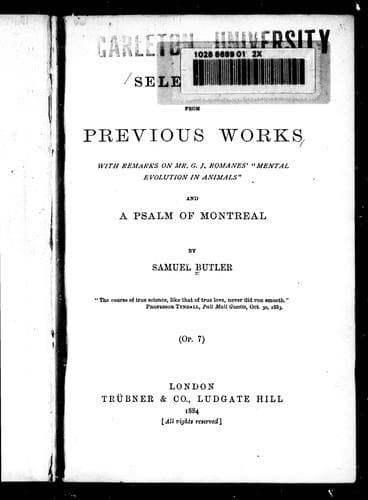
Selections from Previous Works: With Remarks on Romanes' Mental Evolution in Animals, and a Psalm of MontrealButler, Samuel
Philosophy
Selections from Previous Works: With Remarks on Romanes' Mental Evolution in Animals, and a Psalm of Montreal
Butler, Samuel
English literature -- 19th century -- Miscellanea; Romanes, George John, 1848-1894. Mental evolution in animals
It is perhaps necessary to tell the reader that Buffon carried the
foregoing scheme into practice as nearly as he could in the first fifteen
volumes of his Natural History. He begins with man--and then goes on to
the horse, the ass, the cow, sheep, goat, pig, dog, &c. One would be
glad to know whether he found it always more easy to know in what order
of familiarity this or that animal would stand to the majority of his
readers than other classifiers have found it to know whether an
individual more resembles one species or another; probably he never gave
the matter a thought after he had gone through the first dozen most
familiar animals, but settled generally down into a classification which
becomes more and more specific--as when he treats of the apes and
monkeys--till he reaches the birds, when he openly abandons his original
idea, in deference, as he says, to the opinion of "le peuple des
naturalistes."
Perhaps the key to this piece of apparent extravagance is to be found in
the word "mysterieuse." {166c} Buffon wished to raise a standing protest
against mystery mongering. Or perhaps more probably, he wished at once
to turn to animals under domestication, so as to insist early on the main
object of his work--the plasticity of animal forms.
I am inclined to think that a vein of irony pervades the whole or much
the greater part of Buffon's work, and that he intended to convey one
meaning to one set of readers, and another to another; indeed, it is
often impossible to believe that he is not writing between his lines for
the discerning, what the undiscerning were not intended to see. It must
be remembered that his Natural History has two sides,--a scientific and a
popular one. May we not imagine that Buffon would be unwilling to debar
himself from speaking to those who could understand him, and yet would
wish like Handel and Shakespeare to address the many, as well as the few?
But the only manner in which these seemingly irreconcilable ends could be
attained, would be by the use of language which should be self-adjusting
to the capacity of the reader. So keen an observer can hardly have been
blind to the signs of the times which were already close at hand. Free-
thinker though he was, he was also a powerful member of the aristocracy,
and little likely to demean himself--for so he would doubtless hold it--by
playing the part of Voltaire or Rousseau. He would help those who could
see to see still further, but he would not dazzle eyes that were yet
imperfect with a light brighter than they could stand. He would
therefore impose upon people, as much as he thought was for their good;
but, on the other hand, he would not allow inferior men to mystify them.
Public-domain text, read in full here on John Shaqi.
Reviews
Reviews
No reviews yet
Be the first to share your thoughts on this work.
Elsewhere in the archive
Join the Discussion
Join the discussion
Sign in to leave a comment or review.
Sign InorCreate an account