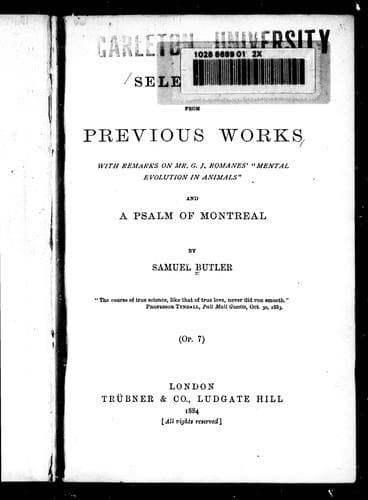
Selections from Previous Works: With Remarks on Romanes' Mental Evolution in Animals, and a Psalm of MontrealButler, Samuel
Philosophy
Selections from Previous Works: With Remarks on Romanes' Mental Evolution in Animals, and a Psalm of Montreal
Butler, Samuel
English literature -- 19th century -- Miscellanea; Romanes, George John, 1848-1894. Mental evolution in animals
This involves the older "Darwinism" and the theory of Lamarck, according
to which the modification of living forms has been effected mainly
through the needs of the living forms themselves, which vary with varying
conditions--the survival of the fittest (which, as I see Mr. H. B.
Baildon has just said, "sometimes comes to mean merely the survival of
the survivors" {181c}) being taken as a matter of course. According to
this view of evolution, there is a remarkable analogy between the
development of living organs, or tools, and that of those organs or tools
external to the body which has been so rapid during the last few thousand
years.
Animals and plants, according to Professor Hering, are guided throughout
their development, and preserve the due order in each step they take,
through memory of the course they took on past occasions when in the
persons of their ancestors. I am afraid I have already too often said
that if this memory remains for long periods together latent and without
effect, it is because the vibrations of the molecular substance of the
body which are its supposed explanation are during these periods too
feeble to generate action, until they are augmented in force through an
accession of similar vibrations issuing from exterior objects; or, in
other words, until recollection is stimulated by a return of the
associated ideas. On this the internal agitation becomes so much
enhanced, that equilibrium is visibly disturbed, and the action ensues
which is proper to the vibrations of the particular substance under the
particular conditions. This, at least, is what I suppose Professor
Hering to intend.
Leaving the explanation of memory on one side, and confining ourselves to
the fact of memory only, a caterpillar on being just hatched is supposed,
according to this theory, to lose its memory of the time it was in the
egg, and to be stimulated by an intense but unconscious recollection of
the action taken by its ancestors when they were first hatched. It is
guided in the course it takes by the experience it can thus command. Each
step it takes recalls a new recollection, and thus it goes through a
development as a performer performs a piece of music, each bar leading
his recollection to the bar that should next follow.
In Life and Habit will be found examples of the manner in which this view
solves a number of difficulties for the explanation of which the leading
men of science express themselves at a loss. The following from
Professor Huxley's recent work upon the crayfish may serve for an
example. Professor Huxley writes:--
Public-domain text, read in full here on John Shaqi.
Reviews
Reviews
No reviews yet
Be the first to share your thoughts on this work.
Elsewhere in the archive
Join the Discussion
Join the discussion
Sign in to leave a comment or review.
Sign InorCreate an account