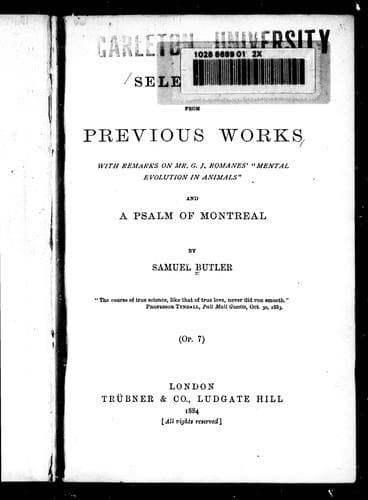
Selections from Previous Works: With Remarks on Romanes' Mental Evolution in Animals, and a Psalm of MontrealButler, Samuel
Philosophy
Selections from Previous Works: With Remarks on Romanes' Mental Evolution in Animals, and a Psalm of Montreal
Butler, Samuel
English literature -- 19th century -- Miscellanea; Romanes, George John, 1848-1894. Mental evolution in animals
"It is a widely received notion that the energies of living matter
have a tendency to decline and finally disappear, and that the death
of the body as a whole is a necessary correlate of its life. That all
living beings sooner or later perish needs no demonstration, but it
would be difficult to find satisfactory grounds for the belief that
they needs must do so. The analogy of a machine, that sooner or later
must be brought to a standstill by the wear and tear of its parts,
does not hold, inasmuch as the animal mechanism is continually renewed
and repaired; and though it is true that individual components of the
body are constantly dying, yet their places are taken by vigorous
successors. A city remains notwithstanding the constant death-rate of
its inhabitants; and such an organism as a crayfish is only a
corporate unity, made up of innumerable partially independent
individualities."--_The Crayfish_, p. 127.
Surely the theory which I have indicated above makes the reason plain why
no organism can permanently outlive its experience of past lives. The
death of such a body corporate as the crayfish is due to the social
condition becoming more complex than there is memory of past experience
to deal with. Hence social disruption, insubordination, and decay. The
crayfish dies as a state dies, and all states that we have heard of die
sooner or later. There are some savages who have not yet arrived at the
conception that death is the necessary end of all living beings, and who
consider even the gentlest death from old age as violent and abnormal; so
Professor Huxley seems to find a difficulty in seeing that though a city
commonly outlives many generations of its citizens, yet cities and states
are in the end no less mortal than individuals. "The _city_," he says,
"remains." Yes, but not for ever. When Professor Huxley can find a city
that will last for ever, he may wonder that a crayfish does not last for
ever.
I have already here and elsewhere said all that I can yet bring forward
in support of Professor Hering's theory; it now remains for me to meet
the most troublesome objection to it that I have been able to think of--an
objection which I had before me when I wrote Life and Habit, but which
then as now I believe to be unsound. Seeing, however, that a plausible
case can be made out for it, I will state it and refute it here. When I
say refute it, I do not mean that I shall have done with it--for it is
plain that it opens up a vaster question in the relations between the so-
called organic and inorganic worlds--but that I will refute the
supposition that it any way militates against Professor Hering's theory.
Public-domain text, read in full here on John Shaqi.
Reviews
Reviews
No reviews yet
Be the first to share your thoughts on this work.
Elsewhere in the archive
Join the Discussion
Join the discussion
Sign in to leave a comment or review.
Sign InorCreate an account