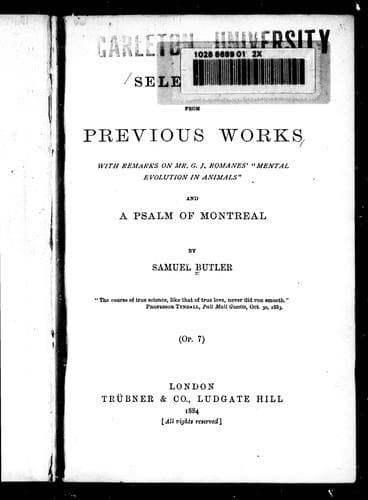
Selections from Previous Works: With Remarks on Romanes' Mental Evolution in Animals, and a Psalm of MontrealButler, Samuel
Philosophy
Selections from Previous Works: With Remarks on Romanes' Mental Evolution in Animals, and a Psalm of Montreal
Butler, Samuel
English literature -- 19th century -- Miscellanea; Romanes, George John, 1848-1894. Mental evolution in animals
What is the offence of a lamb that we should rear it, and tend it, and
lull it into security, for the express purpose of killing it? Its
offence is the misfortune of being something which society wants to eat,
and which cannot defend itself. This is ample. Who shall limit the
right of society except society itself? And what consideration for the
individual is tolerable unless society be the gainer thereby? Wherefore
should a man be so richly rewarded for having been son to a millionaire,
were it not clearly provable that the common welfare is thus better
furthered? We cannot seriously detract from a man's merit in having been
the son of a rich father without imperilling our own tenure of things
which we do not wish to jeopardise; if this were otherwise we should not
let him keep his money for a single hour; we would have it ourselves at
once. For property _is_ robbery, but then we are all robbers or would-be
robbers together, and have found it expedient to organise our thieving,
as we have found it to organise our lust and our revenge. Property,
marriage, the law; as the bed to the river, so rule and convention to the
instinct.
But to return. Even in England a man on board a ship with yellow fever
is held responsible for his mischance, no matter what his being kept in
quarantine may cost him. He may catch the fever and die; we cannot help
it; he must take his chance as other people do; but surely it would be
desperate unkindness to add contumely to our self-protection, unless,
indeed, we believe that contumely is one of our best means of
self-protection. Again, take the case of maniacs. We say that they are
irresponsible for their actions, but we take good care, or ought to take
good care, that they shall answer to us for their insanity, and we
imprison them in what we call an asylum (that modern sanctuary!) if we do
not like their answers. This is a strange kind of irresponsibility. What
we ought to say is that we can afford to be satisfied with a less
satisfactory answer from a lunatic than from one who is not mad, because
lunacy is less infectious than crime.
We kill a serpent if we go in danger by it, simply for being such and
such a serpent in such and such a place; but we never say that the
serpent has only itself to blame for not having been a harmless creature.
Its crime is that of being the thing which it is: but this is a capital
offence, and we are right in killing it out of the way, unless we think
it more dangerous to do so than to let it escape; nevertheless we pity
the creature, even though we kill it.
Public-domain text, read in full here on John Shaqi.
Reviews
Reviews
No reviews yet
Be the first to share your thoughts on this work.
Join the Discussion
Join the discussion
Sign in to leave a comment or review.
Sign InorCreate an account