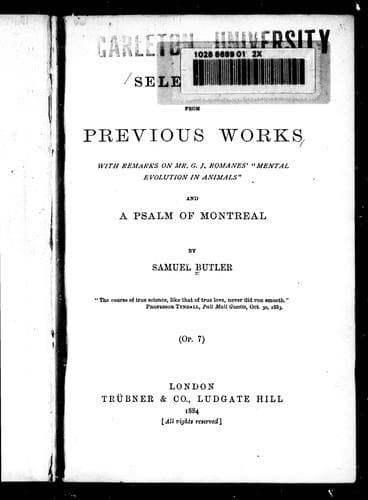
Selections from Previous Works: With Remarks on Romanes' Mental Evolution in Animals, and a Psalm of MontrealButler, Samuel
Philosophy
Selections from Previous Works: With Remarks on Romanes' Mental Evolution in Animals, and a Psalm of Montreal
Butler, Samuel
English literature -- 19th century -- Miscellanea; Romanes, George John, 1848-1894. Mental evolution in animals
What similarity of action can be greater than this, and at the same time
more incontrovertible? But it has nothing to do with memory; on the
contrary, it is just because the clerk has no memory that his action of
the second day so exactly resembles that of the first. As long as he has
no power of recollecting, he will day after day repeat the same actions
in exactly the same way, until some external circumstances, such as his
being sent away, modify the situation. Till this or some other
modification occurs, he will day after day go down into the street
without knowing where to go; day after day he will see the same policeman
at the corner of the same street, and (for we may as well suppose that
the policeman has no memory too) he will ask and be answered, and ask and
be answered, till he and the policeman die of old age. This similarity
of action is plainly due to that--whatever it is--which ensures that like
persons or things when placed in like circumstances shall behave in a
like manner.
Allow the clerk ever such a little memory, and the similarity of action
will disappear; for the fact of remembering what happened to him on the
first day he went out in search of dinner will be a modification in him
in regard to his then condition when he next goes out to get his dinner.
He had no such memory on the first day, and he has upon the second. Some
modification of action must ensue upon this modification of the actor,
and this is immediately observable. He wants his dinner, indeed, goes
down into the street, and sees the policeman as yesterday, but he does
not ask the policeman; he remembers what the policeman told him and what
he did, and therefore goes straight to the eating-house without wasting
time: nor does he dine off the same dish two days running, for he
remembers what he had yesterday and likes variety. If, then, similarity
of action is rather hindered than promoted by memory, why introduce it
into such cases as the repetition of the embryonic processes by
successive generations? The embryos of a well-fixed breed, such as the
goose, are almost as much alike as water is to water, and by consequence
one goose comes to be almost as like another as water to water. Why
should it not be supposed to become so upon the same grounds--namely,
that it is made of the same stuffs, and put together in like proportions
in the same manner?
ON CYCLES. (CHAPTER XI. OF UNCONSCIOUS MEMORY.)
Public-domain text, read in full here on John Shaqi.
Reviews
Reviews
No reviews yet
Be the first to share your thoughts on this work.
Elsewhere in the archive
Join the Discussion
Join the discussion
Sign in to leave a comment or review.
Sign InorCreate an account