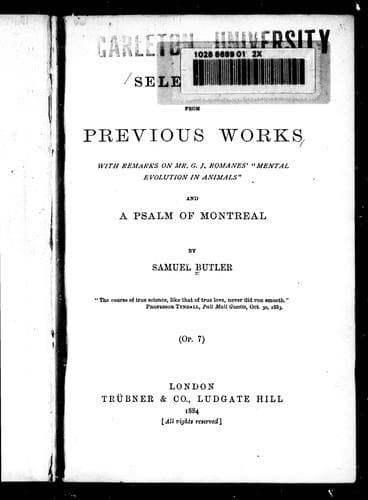
Selections from Previous Works: With Remarks on Romanes' Mental Evolution in Animals, and a Psalm of MontrealButler, Samuel
Philosophy
Selections from Previous Works: With Remarks on Romanes' Mental Evolution in Animals, and a Psalm of Montreal
Butler, Samuel
English literature -- 19th century -- Miscellanea; Romanes, George John, 1848-1894. Mental evolution in animals
I felt inclined to reply that my friend need not twit me with being able
to develop a mental organism if I felt the need of it, for his own
ingenious attack on my position, and indeed every action of his life, was
but an example of this omnipresent principle.
When he was gone, however, I thought over what he had been saying. I
endeavoured to see how far I could get on without volition and memory,
and reasoned as follows:--A repetition of like antecedents will be
certainly followed by a repetition of like consequents, whether the
agents be men and women or chemical substances. "If there be two cowards
perfectly similar in every respect, and if they be subjected in a
perfectly similar way to two terrifying agents, which are themselves
perfectly similar, there are few who will not expect a perfect similarity
in the running away, even though ten thousand years intervene between the
original combination and its repetition." {189} Here certainly there is
no coming into play of memory, more than in the pan of cream on two
successive churning days, yet the action is similar.
A clerk in an office has an hour in the middle of the day for dinner.
About half-past twelve he begins to feel hungry; at one he takes down his
hat and leaves the office. He does not yet know the neighbourhood, and
on getting down into the street asks a policeman at the corner which is
the best eating-house within easy distance. The policeman tells him of
three houses, one of which is a little farther off than the other two,
but is cheaper. Money being a greater object to him than time, the clerk
decides on going to the cheaper house. He goes, is satisfied, and
returns.
Next day he wants his dinner at the same hour, and--it will be
said--remembering his satisfaction of yesterday, will go to the same
place as before. But what has his memory to do with it? Suppose him to
have forgotten all the circumstances of the preceding day from the moment
of his beginning to feel hungry onward, though in other respects sound in
mind and body, and unchanged generally. At half-past twelve he would
begin to be hungry; but his beginning to be hungry cannot be connected
with his remembering having begun to be hungry yesterday. He would begin
to be hungry just as much whether he remembered or no. At one o'clock he
again takes down his hat and leaves the office, not because he remembers
having done so yesterday, but because he wants his hat to go out with.
Being again in the street, and again ignorant of the neighbourhood (for
he remembers nothing of yesterday), he sees the same policeman at the
corner of the street, and asks him the same question as before; the
policeman gives him the same answer, and money being still an object to
him, the cheapest eating-house is again selected; he goes there, finds
the same _menu_, makes the same choice for the same reasons, eats, is
satisfied, and returns.
Public-domain text, read in full here on John Shaqi.
Reviews
Reviews
No reviews yet
Be the first to share your thoughts on this work.
Elsewhere in the archive
Join the Discussion
Join the discussion
Sign in to leave a comment or review.
Sign InorCreate an account