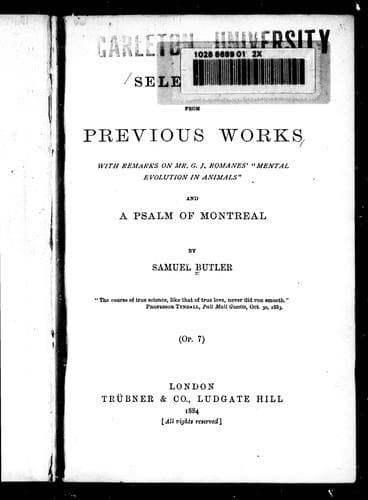
Selections from Previous Works: With Remarks on Romanes' Mental Evolution in Animals, and a Psalm of MontrealButler, Samuel
Philosophy
Selections from Previous Works: With Remarks on Romanes' Mental Evolution in Animals, and a Psalm of Montreal
Butler, Samuel
English literature -- 19th century -- Miscellanea; Romanes, George John, 1848-1894. Mental evolution in animals
There is life infinitely lower and more minute than any which our most
powerful microscopes reveal to us, but let us leave this upon one side
and begin with the amoeba. Let us suppose that this "structureless"
morsel of protoplasm is, for all its "structurelessness," composed of an
infinite number of living molecules, each one of them with hopes and
fears of its own, and all dwelling together like Tekke Turcomans, of whom
we read that they live for plunder only, and that each man of them is
entirely independent, acknowledging no constituted authority, but that
some among them exercise a tacit and undefined influence over the others.
Let us suppose these molecules capable of memory, both in their capacity
as individuals and as societies, and able to transmit their memories to
their descendants from the traditions of the dimmest past to the
experiences of their own lifetime. Some of these societies will remain
simple, as having had no history, but to the greater number unfamiliar,
and therefore striking, incidents will from time to time occur, which,
when they do not disturb memory so greatly as to kill, will leave their
impression upon it. The body or society will remember these incidents
and be modified by them in its conduct, and therefore more or less in its
internal arrangements, which will tend inevitably to specialisation. This
memory of the most striking events of varied lifetimes I maintain, with
Professor Hering, to be the differentiating cause, which, accumulated in
countless generations, has led up from the amoeba to man. If there had
been no such memory, the amoeba of one generation would have exactly
resembled the amoeba of the preceding, and a perfect cycle would have
been established; the modifying effects of an additional memory in each
generation have made the cycle into a spiral, and into a spiral whose
eccentricities, in the outset hardly perceptible, is becoming greater and
greater with increasing longevity and more complex social and mechanical
inventions.
Public-domain text, read in full here on John Shaqi.
Reviews
Reviews
No reviews yet
Be the first to share your thoughts on this work.
Elsewhere in the archive
Join the Discussion
Join the discussion
Sign in to leave a comment or review.
Sign InorCreate an account