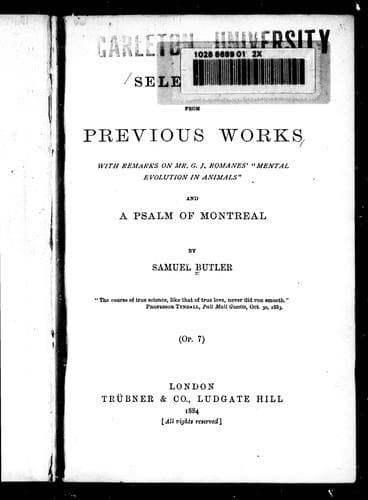
Selections from Previous Works: With Remarks on Romanes' Mental Evolution in Animals, and a Psalm of MontrealButler, Samuel
Philosophy
Selections from Previous Works: With Remarks on Romanes' Mental Evolution in Animals, and a Psalm of Montreal
Butler, Samuel
English literature -- 19th century -- Miscellanea; Romanes, George John, 1848-1894. Mental evolution in animals
We say that the chicken grows the horny tip to its beak with which it
ultimately pecks its way out of its shell, because it remembers having
grown it before, and the use it made of it. We say that it made it on
the same principles as a man makes a spade or a hammer, that is to say,
as the joint result both of desire and experience. When I say
experience, I mean, experience not only of what will be wanted, but also
of the details of all the means that must be taken in order to effect
this. Memory, therefore, is supposed to guide the chicken not only in
respect of the main design, but in respect also of every atomic action,
so to speak, which goes to make up the execution of this design. It is
not only the suggestion of a plan which is due to memory, but, as
Professor Hering has so well said, it is the binding power of memory
which alone renders any consolidation or coherence of action possible,
inasmuch as without this no action could have parts subordinate one to
another, yet bearing upon a common end; no part of an action, great or
small, could have reference to any other part, much less to a combination
of all the parts; nothing, in fact, but ultimate atoms of actions could
ever happen--these bearing the same relation to such an action, we will
say, as a railway journey from London to Edinburgh as a single molecule
of hydrogen to a gallon of water.
If asked how it is that the chicken shows no sign of consciousness
concerning this design, nor yet of the steps it is taking to carry it
out, we reply that such unconsciousness is usual in all cases where an
action, and the design which prompts it, have been repeated exceedingly
often. If, again, we are asked how we account for the regularity with
which each step is taken in its due order, we answer that this too is
characteristic of actions that are done habitually--they being very
rarely misplaced in respect of any part.
Public-domain text, read in full here on John Shaqi.
Reviews
Reviews
No reviews yet
Be the first to share your thoughts on this work.
Elsewhere in the archive
Join the Discussion
Join the discussion
Sign in to leave a comment or review.
Sign InorCreate an account