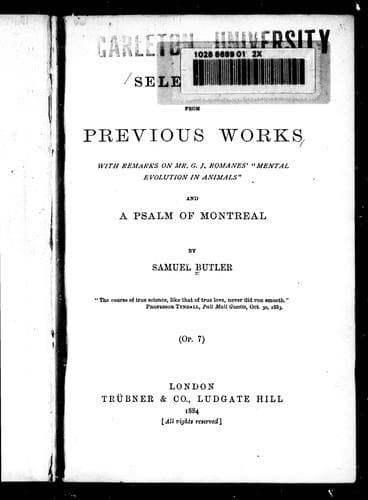
Selections from Previous Works: With Remarks on Romanes' Mental Evolution in Animals, and a Psalm of MontrealButler, Samuel
Philosophy
Selections from Previous Works: With Remarks on Romanes' Mental Evolution in Animals, and a Psalm of Montreal
Butler, Samuel
English literature -- 19th century -- Miscellanea; Romanes, George John, 1848-1894. Mental evolution in animals
Professor Hering does mean this, and makes it clear that he does so. He
does not catch the ball and let it slip through his fingers again, but
holds it firmly. "It is to memory," he says, "that we owe almost all
that we have or are; our ideas and conceptions are its work; our every
thought and movement are derived from this source. Memory connects the
countless phenomena of our existence into a single whole, and as our
bodies would be scattered into the dust of their component atoms if they
were not held together by the cohesion of matter, so our consciousness
would be broken up into as many moments as we had lived seconds, but for
the binding and unifying force of Memory." {229} And he proceeds to show
that Memory persists between generations exactly as it does between the
various stages in the life of the individual. If I could find any such
passage as the one I have just quoted, in Mr. Herbert Spencer's, Mr.
Lewes's, or Mr. Romanes' works, I should be only too glad to quote it,
but I know of nothing comparable to it for definiteness of idea,
thoroughness and consistency.
No reader indeed can rise from a perusal of Mr. Herbert Spencer's, or Mr.
G. H. Lewes', work with an adequate--if indeed with any--impression that
the phenomena of heredity are in fact phenomena of memory; that heredity,
whether as regards body or mind, is only possible because each generation
is linked on to and made one with its predecessor by the possession of a
common and abiding memory, in as far as bodily existence was common--that
is to say, until the substance of the one left the substance of the
other; and that this memory is exactly of the same general character as
that which enables us to remember what we did half an hour ago--strong
under the same circumstances as those under which this familiar kind of
memory is strong, and weak under those under which it is weak. Mr.
Spencer and Mr. Lewes have even less conception of the connection between
heredity and memory than Dr. Erasmus Darwin had at the close of the last
century. {230}
Mr. Lewes' position was briefly this. He denied that there could be any
knowledge independent of experience, but he could not help seeing that
young animals come into the world furnished with many organs which they
use with great dexterity at a very early age. This looks as if they are
acting on knowledge acquired independently of experience. "No," says Mr.
Lewes, "not so. They are born with the organs--I cannot tell how or why,
but heredity explains all that, and having once got the organs, the
objects that come into contact with them in daily life naturally produce
the same effect as on the parents, just as oxygen coming into contact
with the right quantity of hydrogen will make water; hence even the first
time the offspring come into contact with any given object they act as
their parents did." The idea of the young having got their experience in
a past generation does not seem to have even crossed his mind.
Public-domain text, read in full here on John Shaqi.
Reviews
Reviews
No reviews yet
Be the first to share your thoughts on this work.
Elsewhere in the archive
Join the Discussion
Join the discussion
Sign in to leave a comment or review.
Sign InorCreate an account