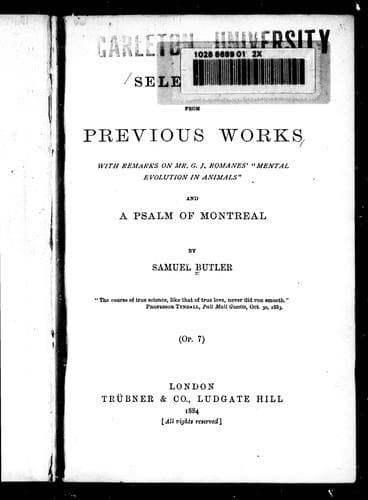
Selections from Previous Works: With Remarks on Romanes' Mental Evolution in Animals, and a Psalm of MontrealButler, Samuel
Philosophy
Selections from Previous Works: With Remarks on Romanes' Mental Evolution in Animals, and a Psalm of Montreal
Butler, Samuel
English literature -- 19th century -- Miscellanea; Romanes, George John, 1848-1894. Mental evolution in animals
"What marvel is there," he asks, "that constant conditions acting upon
structures which are similar should produce similar results? It is in
this sense that the paradox of Leibnitz is true, and we can be said 'to
acquire an innate idea;' only the idea is not acquired independently of
experience, but through the process of experience similar to that which
originally produced it." {231a}
The impression left upon me is that he is all at sea for want of the clue
with which Professor Hering would have furnished him, and that had that
clue been presented to him a dozen years or so earlier than it was he
would have adopted it.
As regards Mr. Romanes the case is different. His recent work, Mental
Evolution in Animals, {231b} shows that he is well aware of the direction
which modern opinion is taking, and in several places he so writes as to
warrant me in claiming his authority in support of the views which I have
been insisting on for several years past.
Thus Mr. Romanes says that the analogies between the memory with which we
are familiar in daily life and hereditary memory "are so numerous and
precise" as to justify us in considering them to be of essentially the
same kind. {232a}
Again he says that although the memory of milk shown by new-born infants
is "at all events in large part hereditary, it is none the less memory"
of a certain kind. {232b}
Two lines lower down he writes of "hereditary memory or instinct,"
thereby implying that instinct is "hereditary memory." "It makes no
essential difference," he says, "whether the past sensation was actually
experienced by the individual itself, or bequeathed it, so to speak, by
its ancestors. {232c} For it makes no essential difference whether the
nervous changes . . . were occasioned during the lifetime of the
individual or during that of the species, and afterwards impressed by
heredity on the individual."
Lower down on the same page he writes:--
"As showing how close is the connection between hereditary memory and
instinct," &c.
And on the following page:--
"And this shows how closely the phenomena of hereditary memory are
related to those of individual memory: at this stage . . . it is
practically impossible to disentangle the effects of hereditary memory
from those of the individual."
Again:--
Public-domain text, read in full here on John Shaqi.
Reviews
Reviews
No reviews yet
Be the first to share your thoughts on this work.
Elsewhere in the archive
Join the Discussion
Join the discussion
Sign in to leave a comment or review.
Sign InorCreate an account