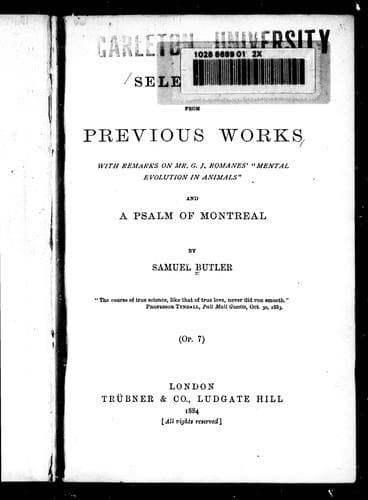
Selections from Previous Works: With Remarks on Romanes' Mental Evolution in Animals, and a Psalm of MontrealButler, Samuel
Philosophy
Selections from Previous Works: With Remarks on Romanes' Mental Evolution in Animals, and a Psalm of Montreal
Butler, Samuel
English literature -- 19th century -- Miscellanea; Romanes, George John, 1848-1894. Mental evolution in animals
This is certainly his meaning, but, with the exception of the words
within inverted commas, it is not his language. His own words are
these:--
"Profound, however, as our ignorance unquestionably is concerning the
physical substratum of memory, I think we are at least justified in
regarding this substratum as the same both in ganglionic or organic,
and in conscious or psychological memory, seeing that the analogies
between them are so numerous and precise. Consciousness is but an
adjunct which arises when the physical processes, owing to infrequency
of repetition, complexity of operation, or other causes, involve what
I have before called ganglionic friction."
I submit that I have correctly translated Mr. Romanes' meaning, and also
that we have a right to complain of his not saying what he has to say in
words which will involve less "ganglionic friction" on the part of the
reader.
Another example may be found on p. 43 of Mr. Romanes' book. "Lastly," he
writes, "just as innumerable special mechanisms of muscular
co-ordinations are found to be inherited, innumerable special
associations of ideas are found to be the same, and in one case as in the
other the strength of the organically imposed connection is found to bear
a direct proportion to the frequency with which in the history of the
species it has occurred."
Mr. Romanes is here intending what the reader will find insisted on on p.
98 of the present volume; but how difficult he has made what could have
been said intelligibly enough, if there had been nothing but the reader's
comfort to be considered. Unfortunately that seems to have been by no
means the only thing of which Mr. Romanes was thinking, or why, after
implying and even saying over and over again that instinct is inherited
habit due to inherited memory, should he turn sharply round on p. 297 and
praise Mr. Darwin for trying to snuff out "the well-known doctrine of
inherited habit as advanced by Lamarck"? The answer is not far to seek.
It is because Mr. Romanes did not merely want to tell us all about
instinct, but wanted also, if I may use a homely metaphor, to hunt with
the hounds and run with the hare at one and the same time.
Public-domain text, read in full here on John Shaqi.
Reviews
Reviews
No reviews yet
Be the first to share your thoughts on this work.
Elsewhere in the archive
Join the Discussion
Join the discussion
Sign in to leave a comment or review.
Sign InorCreate an account