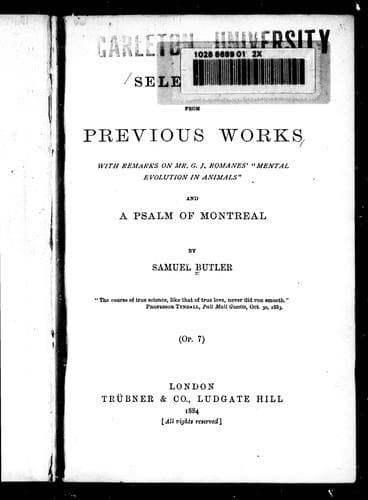
Selections from Previous Works: With Remarks on Romanes' Mental Evolution in Animals, and a Psalm of MontrealButler, Samuel
Philosophy
Selections from Previous Works: With Remarks on Romanes' Mental Evolution in Animals, and a Psalm of Montreal
Butler, Samuel
English literature -- 19th century -- Miscellanea; Romanes, George John, 1848-1894. Mental evolution in animals
Over and over again Mr. Romanes insists that it is heredity which does
this or that. Thus it is "_heredity with natural selection which adapt_
the anatomical plan of the ganglia." {236b} It is heredity which
impresses nervous changes on the individual. {236c} "In the lifetime of
species actions originally intelligent may by frequent repetition _and
heredity_," &c. {236d}; but he nowhere tells us what heredity is any more
than Messrs. Herbert Spencer, Darwin, and Lewes have done. This,
however, is, exactly what Professor Hering, whom I have unwittingly
followed, does. He resolves all phenomena of heredity, whether in
respect of body or mind, into phenomena of memory. He says in effect, "A
man grows his body as he does, and a bird makes her nest as she does,
because both man and bird remember having grown body and made nest as
they now do, or very nearly so, on innumerable past occasions." He thus
reduces life from an equation of say 100 unknown quantities to one of 99
only by showing that heredity and memory, two of the original 100 unknown
quantities, are in reality part of one and the same thing.
That he is right Mr. Romanes seems to me to admit, though in a very
unsatisfactory way.
REMARKS ON MR. ROMANES' MENTAL EVOLUTION IN ANIMALS--(_continued_).
I will give examples of my meaning. Mr. Romanes says on an early page,
"The most fundamental principle of mental operation is that of memory,
for this is the _conditio sine qua non_ of all mental life" (page 35).
I do not understand Mr. Romanes to hold that there is any living being
which has no mind at all, and I do understand him to admit that
development of body and mind are closely interdependent.
If then, "the most fundamental principle" of mind is memory, it follows
that memory enters also as a fundamental principle into development of
body. For mind and body are so closely connected that nothing can enter
largely into the one without correspondingly affecting the other.
On a later page, indeed, Mr. Romanes speaks point-blank of the new-born
child as "_embodying_ the results of a great mass of _hereditary
experience_" (p. 77), so that what he is driving at can be collected by
those who take trouble, but is not seen until we call up from our own
knowledge matter whose relevancy does not appear on the face of it, and
until we connect passages many pages asunder, the first of which may
easily be forgotten before we reach the second. There can be no doubt,
however, that Mr. Romanes does in reality, like Professor Hering and
myself, regard development, whether of mind or body, as due to memory,
for it is nonsense indeed to talk about "hereditary experience" or
"hereditary memory" if anything else is intended.
I have said above that on page 113 of his recent work Mr. Romanes
declares the analogies between the memory with which we are familiar in
daily life, and hereditary memory, to be "so numerous and precise" as to
justify us in considering them as of one and the same kind.
Public-domain text, read in full here on John Shaqi.
Reviews
Reviews
No reviews yet
Be the first to share your thoughts on this work.
Elsewhere in the archive
Join the Discussion
Join the discussion
Sign in to leave a comment or review.
Sign InorCreate an account