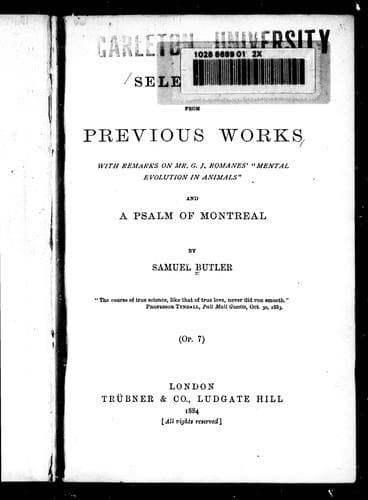
Selections from Previous Works: With Remarks on Romanes' Mental Evolution in Animals, and a Psalm of MontrealButler, Samuel
Philosophy
Selections from Previous Works: With Remarks on Romanes' Mental Evolution in Animals, and a Psalm of Montreal
Butler, Samuel
English literature -- 19th century -- Miscellanea; Romanes, George John, 1848-1894. Mental evolution in animals
Curiously enough, Mr. Grant Allen too has come to much the same
conclusions as myself, after having attacked me, though not so fiercely,
as Mr. Romanes has done. In 1879 he said in the _Examiner_ (May 17) that
the teleological view put forward in Evolution, Old and New, was "just
the sort of mystical nonsense from which" he "had hoped Mr. Darwin had
for ever saved us." And so in the _Academy_ on the same day he said that
no "one-sided argument" (referring to Evolution, Old and New) could ever
deprive Mr. Darwin of the "place which he had eternally won in the
history of human thought by his magnificent achievement."
A few years, and Mr. Allen entertains a very different opinion of Mr.
Darwin's magnificent achievement.
"There are only two conceivable ways," he writes, "in which any increment
of brain power can ever have arisen in any individual. The one is the
Darwinian way, by 'spontaneous variation,' that is to say by variation
due to minute physical circumstances affecting the individual in the
germ. The other is the Spencerian way, by functional increment, that is
to say by the effect of increased use and constant exposure to varying
circumstances during conscious life." {250}
Mr. Allen must know very well, or if he does not he has no excuse at any
rate for not knowing, that the theory according to which increase of
brain power or any other bodily or mental power is due to use, is no more
Mr. Spencer's than the theory of gravitation is, except in so far as that
Mr. Spencer has adopted it. It is the theory which every one except Mr.
Allen associates with Erasmus Darwin and Lamarck, but more especially
(and on the whole I suppose justly) with Lamarck.
"I venture to think," continues Mr. Allen, "that the first way [Mr.
Darwin's], if we look it clearly in the face, will be seen to be
_practically unthinkable_; and that we have therefore no alternative but
to accept the second."
These writers go round so quickly and so completely that there is no
keeping pace with them. "As to Materialism," he writes presently,
"surely it is more profoundly materialistic to suppose that mere physical
causes operating on the germ can determine minute physical and material
changes in the brain, which will in turn make the individuality what it
is to be, than to suppose _that all brains are what they are in virtue of
antecedent function_. The one creed makes the man depend mainly upon the
accidents of molecular physics in a colliding germ cell and sperm cell;
_the other makes him depend mainly upon the doings and gains of his
ancestors as modified and altered by himself_."
Here is a sentence taken almost at random from the body of the article:--
Public-domain text, read in full here on John Shaqi.
Reviews
Reviews
No reviews yet
Be the first to share your thoughts on this work.
Elsewhere in the archive
Join the Discussion
Join the discussion
Sign in to leave a comment or review.
Sign InorCreate an account