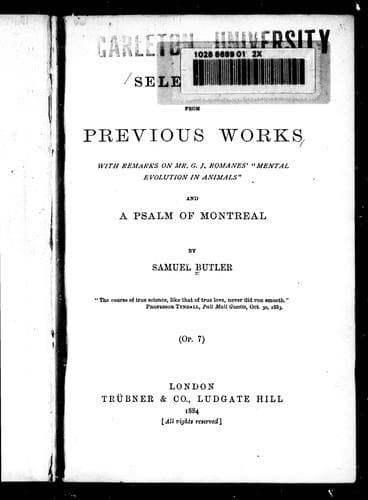
Selections from Previous Works: With Remarks on Romanes' Mental Evolution in Animals, and a Psalm of MontrealButler, Samuel
Philosophy
Selections from Previous Works: With Remarks on Romanes' Mental Evolution in Animals, and a Psalm of Montreal
Butler, Samuel
English literature -- 19th century -- Miscellanea; Romanes, George John, 1848-1894. Mental evolution in animals
"We are always seeing something which adds to our total stock of
memories; we are always learning and doing something new. The vast
majority of these experiences are similar in kind to those already
passed through by our ancestors: they add nothing to the inheritance
of the race. . . . Though they leave physical traces on the
individual, they do not so far affect the underlying organisation of
the brain as to make the development of after-brains somewhat
different from previous ones. But there are certain functional
activities which do tend so to alter the development of after-brains;
certain novel or sustained activities which apparently result in the
production of new correlated brain elements or brain connections
hereditarily transmissible as increased potentialities of similar
activity in the offspring."
Of Natural Selection Mr. Allen writes much, as Professor Mivart and
others have been writing for many years past.
"It seems to me," he says, "easy to understand how survival of the
fittest may result in progress starting from such functionally produced
gains, but impossible to understand how it could result in progress if it
had to start in mere accidental structural increments due to spontaneous
variation alone." {252a}
Mr. Allen may say this now, but until lately he has been among the first
to scold any one else who said so.
And this is how the article concludes:--
"The first hypothesis (Mr Darwin's) is one that throws no light upon any
of the facts. The second hypothesis (which Mr. Allen is pleased to call
Mr. Herbert Spencer's) is one that explains them all with transparent
lucidity." {252b}
So that Mr. Darwin, according to Mr. Allen, is clean out of it. Truly
when Mr. Allen makes stepping-stones of his dead selves, he jumps upon
them to some tune. But then Mr. Darwin is dead now. I have not heard of
his having given Mr. Allen any manuscripts as he gave Mr. Romanes. I
hope Mr. Herbert Spencer will not give him any. If I was Mr. Spencer and
found my admirers crowning me with Lamarck's laurels, I think I should
have something to say to them.
What are we to think of a writer who declares that the theory that
specific and generic changes are due to use and disuse "explains _all the
facts_ with transparent lucidity"?
Public-domain text, read in full here on John Shaqi.
Reviews
Reviews
No reviews yet
Be the first to share your thoughts on this work.
Elsewhere in the archive
Join the Discussion
Join the discussion
Sign in to leave a comment or review.
Sign InorCreate an account