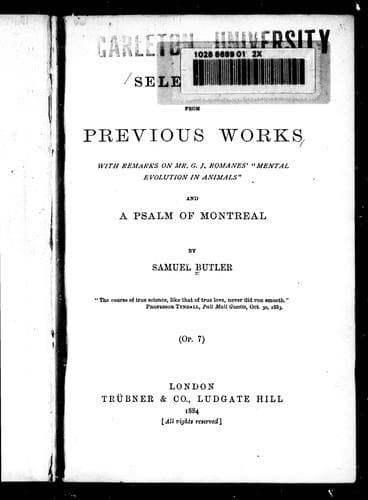
Selections from Previous Works: With Remarks on Romanes' Mental Evolution in Animals, and a Psalm of MontrealButler, Samuel
Philosophy
Selections from Previous Works: With Remarks on Romanes' Mental Evolution in Animals, and a Psalm of Montreal
Butler, Samuel
English literature -- 19th century -- Miscellanea; Romanes, George John, 1848-1894. Mental evolution in animals
Lamarck's hypothesis is no doubt a great help and a great step toward
Professor Hering's; it makes a known cause underlie variations, and thus
is free from those fatal objections which Professor Mivart and others
have brought against the theory of Messrs. Darwin and Wallace; but how
does the theory that use develops an organism explain why offspring
repeat the organism at all? How does the Lamarckian hypothesis explain
the sterility of hybrids, for example? The sterility of hybrids has been
always considered one of the great _cruces_ in connection with any theory
of Evolution. How again does it explain reversion to long-lost
characters and the resumption of feral characteristics? the phenomena of
old age? the principle that underlies longevity? the reason why the
reproductive system is generally the last to arrive at maturity, and why
few further developments take place in any organism after this has been
fully developed? the sterility of many animals under captivity? the
development in both males and females, under certain circumstances, of
the characteristics of the opposite sex? the latency of memory? the
unconsciousness with which we develop, and with which instinctive actions
are performed? How does any theory advanced either by Lamarck, Mr.
Herbert Spencer, or Mr. Darwin explain, or indeed throw light upon these
facts until supplemented with the explanation given of them in Life and
Habit--for which I must refer the reader to that work itself?
People may say what they like about "the experience of the race," {254a}
"the registration of experiences continued for numberless generations,"
{254b} "infinity of experiences," {254c} "lapsed intelligence," &c., but
until they make Memory, in the most uncompromising sense of the word, the
key to all the phenomena of Heredity, they will get little help to the
better understanding of the difficulties above adverted to. Add this to
the theory of Buffon, Erasmus Darwin, and Lamarck, and the points which I
have above alluded to receive a good deal of "lucidity."
But to return to Mr. Romanes: however much he and Mr. Allen may differ
about the merits of Mr. Darwin, they were at any rate not long since
cordially agreed in vilipending my unhappy self, and are now saying very
much what I have been saying for some years past. I do not deny that
they are capable witnesses. They will generally see a thing when a
certain number of other people have come to do so. I submit that, no
matter how grudgingly they give their evidence, the tendency of that
evidence is sufficiently clear to show that the opinions put forward in
Life and Habit, Evolution, Old and New, and Unconscious Memory, deserve
the attention of the reader.
Public-domain text, read in full here on John Shaqi.
Reviews
Reviews
No reviews yet
Be the first to share your thoughts on this work.
Elsewhere in the archive
Join the Discussion
Join the discussion
Sign in to leave a comment or review.
Sign InorCreate an account