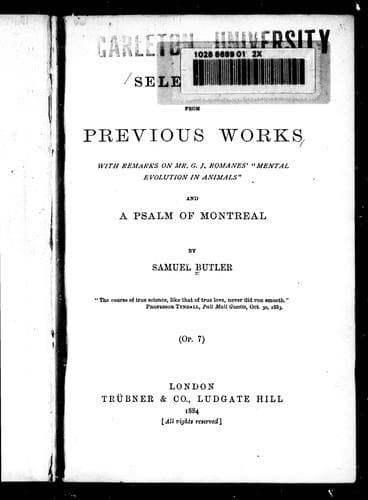
Selections from Previous Works: With Remarks on Romanes' Mental Evolution in Animals, and a Psalm of MontrealButler, Samuel
Philosophy
Selections from Previous Works: With Remarks on Romanes' Mental Evolution in Animals, and a Psalm of Montreal
Butler, Samuel
English literature -- 19th century -- Miscellanea; Romanes, George John, 1848-1894. Mental evolution in animals
There should be a little shock, or there will be no variation in the new
ideas that are generated, but they will resemble those that preceded
them, and grief will be continued; there must not be too great a shock or
there will be no illusion--no confusion and fusion between the new set of
ideas and the old, and in consequence there will be no result at all, or,
if any, an increase in mental discord. We know very little, however,
upon this subject, and are continually shown to be at fault by finding an
unexpectedly small cross produce a wide diversion of the mental images,
while in other cases a wide one will produce hardly any result. Sometimes
again, a cross which we should have said was much too wide will have an
excellent effect. I did not anticipate, for example, that my saying
"chow" would have done much for the poor woman who had lost her daughter:
the cross did not seem wide enough: she was already, as I thought,
saturated with "chow." I can only account for the effect my application
of it produced by supposing the word to have derived some element of
strangeness and novelty as coming from a foreigner--just as land which
will give a poor crop, if planted with sets from potatoes that have been
grown for three or four years on this same soil, will yet yield
excellently if similar sets be brought from twenty miles off. For the
potato, so far as I have studied it, is a good-tempered, frivolous plant,
easily amused and easily bored, and one, moreover, which if bored, yawns
horribly.
I may say in passing that the tempers of plants have not been
sufficiently studied; and what little opinion we have formed about their
dispositions is for the most part ill formed. The sulkiest tree that I
know is the silver beech. It never forgives a scratch.--There is a tree
in Kensington gardens a little off the west side of the Serpentine with
names cut upon it as long ago as 1717 and 1736, which the tree is as
little able to forgive and forget as though the injury had been done not
ten years since. And the tree is not an aged tree either.
CALONICO. (FROM CHAPTER V. OF ALPS AND SANCTUARIES.)
Public-domain text, read in full here on John Shaqi.
Reviews
Reviews
No reviews yet
Be the first to share your thoughts on this work.
Elsewhere in the archive
Join the Discussion
Join the discussion
Sign in to leave a comment or review.
Sign InorCreate an account