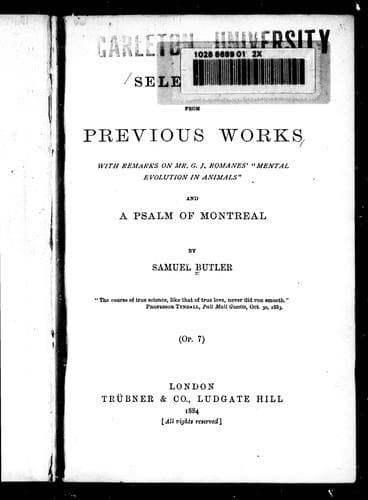
Selections from Previous Works: With Remarks on Romanes' Mental Evolution in Animals, and a Psalm of MontrealButler, Samuel
Philosophy
Selections from Previous Works: With Remarks on Romanes' Mental Evolution in Animals, and a Psalm of Montreal
Butler, Samuel
English literature -- 19th century -- Miscellanea; Romanes, George John, 1848-1894. Mental evolution in animals
Our inventions increase in geometrical ratio. They are like living
beings, each one of which may become parent of a dozen others--some good
and some ne'er-do-weels; but they differ from animals and vegetables
inasmuch as they not only increase in a geometrical ratio, but the period
of their gestation decreases in geometrical ratio also. Take this matter
of Alpine roads for example. For how many millions of years was there no
approach to a road over the St. Gothard, save the untutored watercourses
of the Ticino and the Reuss, and the track of the bouquetin or the
chamois? For how many more ages after this was there not a mere
shepherd's or huntsman's path by the river-side--without so much as a log
thrown over so as to form a rude bridge? No one would probably have ever
thought of making a bridge out of his own unaided imagination, more than
any monkey that we know of has done so. But an avalanche or a flood once
swept a pine into position and left it there; on this a genius, who was
doubtless thought to be doing something very infamous, ventured to make
use of it. Another time a pine was found nearly across the stream, but
not quite; and not quite, again, in the place where it was wanted. A
second genius, to the horror of his fellow-tribesmen--who declared that
this time the world really would come to an end--shifted the pine a few
feet so as to bring it across the stream and into the place where it was
wanted. This man was the inventor of bridges--his family repudiated him,
and he came to a bad end. From this to cutting down the pine and
bringing it from some distance is an easy step. To avoid detail, let us
come to the old Roman horse-road over the Alps. The time between the
shepherd's path and the Roman road is probably short in comparison with
that between the mere chamois track and the first thing that can be
called a path of men. From the Roman we go on to the mediaeval road with
more frequent stone bridges, and from the mediaeval to the Napoleonic
carriage-road.
The close of the last century and the first quarter of this present one
was the great era for the making of carriage-roads. Fifty years have
hardly passed, and here we are already in the age of tunnelling and
railroads. The first period, from the chamois track to the foot road,
was one of millions of years; the second, from the first foot road to the
Roman military way, was one of many thousands; the third, from the Roman
to the mediaeval, was perhaps a thousand; from the mediaeval to the
Napoleonic, five hundred; from the Napoleonic to the railroad, fifty.
What will come next we know not, but it should come within twenty years,
and will probably have something to do with electricity.
Public-domain text, read in full here on John Shaqi.
Reviews
Reviews
No reviews yet
Be the first to share your thoughts on this work.
Elsewhere in the archive
Join the Discussion
Join the discussion
Sign in to leave a comment or review.
Sign InorCreate an account