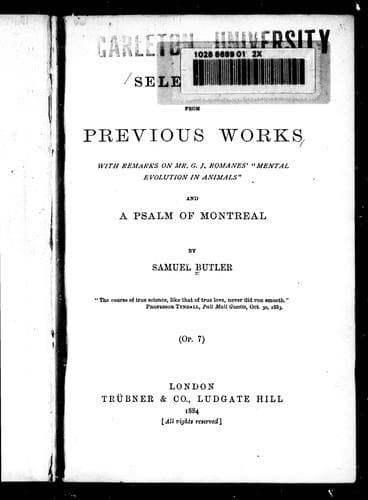
Selections from Previous Works: With Remarks on Romanes' Mental Evolution in Animals, and a Psalm of MontrealButler, Samuel
Philosophy
Selections from Previous Works: With Remarks on Romanes' Mental Evolution in Animals, and a Psalm of Montreal
Butler, Samuel
English literature -- 19th century -- Miscellanea; Romanes, George John, 1848-1894. Mental evolution in animals
As soon as we can find gradations, or a sufficient number of uniting
links between two things, they become united or made one thing, and any
classification of them must be illusory. Classification is only possible
where there is a shock given to the senses by reason of a perceived
difference, which, if it is considerable, can be expressed in words. When
the world was younger and less experienced, people were shocked at what
appeared great differences between living forms; but species, whether of
animals or plants, are now seen to be so united, either inferentially or
by actual finding of the links, that all classification is felt to be
arbitrary. The seasons are like species--they were at one time thought
to be clearly marked, and capable of being classified with some approach
to satisfaction. It is now seen that they blend either in the present or
the past insensibly into one another, much as Mr. Herbert Spencer shows
us that geology and astronomy blend into one another, {265} and cannot be
classified except by cutting Gordian knots in a way which none but plain
sensible people can tolerate. Strictly speaking, there is only one
place, one time, one action, and one individual or thing; of this thing
or individual each one of us is a part. It is perplexing, but it is
philosophy; and modern philosophy, like modern music, is nothing if it is
not perplexing.
A simple verification of the autumnal character of rhubarb may, at first
sight, appear to be found in Covent Garden Market, where we can actually
see the rhubarb towards the end of October. But this way of looking at
the matter argues a fatal ineptitude for the pursuit of true philosophy.
It would be "the most serious error" to regard the rhubarb that will
appear in Covent Garden Market next October as belonging to the autumn
then supposed to be current. Practically, no doubt, it does so, but
theoretically it must be considered as the first-fruits of the autumn (if
any) of the following year, which begins before the preceding summer (or,
perhaps, more strictly, the preceding summer but one--and hence, but any
number), has well ended. Whether this, however, is so or no, the rhubarb
can be seen in Covent Garden, and I am afraid it must be admitted that to
the philosophically minded there lurks within it a theory of evolution,
and even Pantheism, as surely as Theism was lurking in Bishop Berkeley's
tar-water.
To return, however, to Calonico. The _curato_ was very kind to me. We
had long talks together. I could see it pained him that I was not a
Catholic. He could never quite get over this, but he was very good and
tolerant. He was anxious to be assured that I was not one of those
English who went about distributing tracts, and trying to convert people.
This of course was the last thing I should have wished to do; and when I
told him so, he viewed me with sorrow but henceforth without alarm.
Public-domain text, read in full here on John Shaqi.
Reviews
Reviews
No reviews yet
Be the first to share your thoughts on this work.
Elsewhere in the archive
Join the Discussion
Join the discussion
Sign in to leave a comment or review.
Sign InorCreate an account