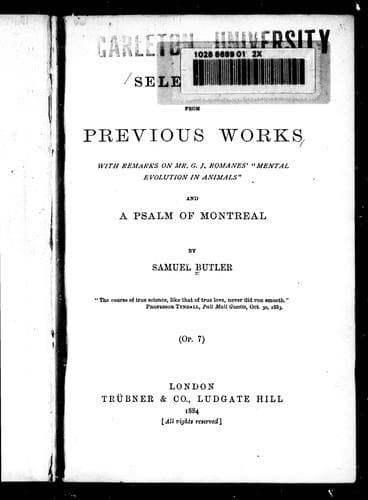
Selections from Previous Works: With Remarks on Romanes' Mental Evolution in Animals, and a Psalm of MontrealButler, Samuel
Philosophy
Selections from Previous Works: With Remarks on Romanes' Mental Evolution in Animals, and a Psalm of Montreal
Butler, Samuel
English literature -- 19th century -- Miscellanea; Romanes, George John, 1848-1894. Mental evolution in animals
It follows by an easy process of reasoning that after another couple of
hundred years or so, great sweeping changes should be made several times
in an hour, or indeed in a second, or fraction of a second, till they
pass unnoticed as the revolutions we undergo in the embryonic stages, or
are felt simply as vibrations. This would undoubtedly be the case but
for the existence of a friction which interferes between theory and
practice. This friction is caused partly by the disturbance of vested
interests which every invention involves, and which will be found
intolerable when men become millionaires and paupers alternately once a
fortnight--living one week in a palace and the next in a workhouse, and
having perpetually to be sold up, and then to buy a new house and
refurnish, &c.--so that artificial means for stopping inventions will be
adopted; and partly by the fact that though all inventions breed in
geometrical ratio, yet some multiply more rapidly than others, and the
backwardness of one art will impede the forwardness of another. At any
rate, so far as I can see, the present is about the only comfortable time
for a man to live in, that either ever has been or ever will be. The
past was too slow, and the future will be much too fast.
The fact is (but it is so obvious that I am ashamed to say anything about
it) that science is rapidly reducing time and space to a very
undifferentiated condition. Take lamb: we can get lamb all the year
round. This is perpetual spring; but perpetual spring is no spring at
all; it is not a season; there are no more seasons, and being no seasons,
there is no time. Take rhubarb, again. Rhubarb to the philosopher is
the beginning of autumn, if indeed the philosopher can see anything as
the beginning of anything. If any one asks why, I suppose the
philosopher would say that rhubarb is the beginning of the fruit season,
which is clearly autumnal, according to our present classification. From
rhubarb to the green gooseberry the step is so small as to require no
bridging--with one's eyes shut, and plenty of cream and sugar, they are
almost indistinguishable--but the gooseberry is quite an autumnal fruit,
and only a little earlier than apples and plums, which last are almost
winter; clearly, therefore, for scientific purposes rhubarb is autumnal.
Public-domain text, read in full here on John Shaqi.
Reviews
Reviews
No reviews yet
Be the first to share your thoughts on this work.
Elsewhere in the archive
Join the Discussion
Join the discussion
Sign in to leave a comment or review.
Sign InorCreate an account