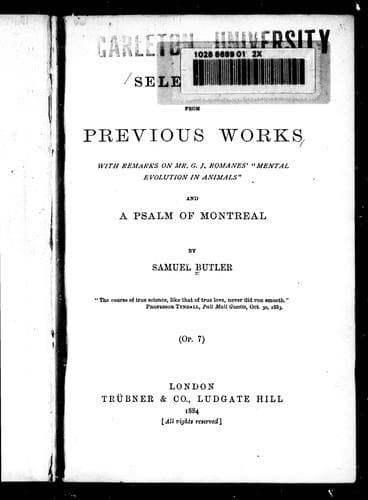
Selections from Previous Works: With Remarks on Romanes' Mental Evolution in Animals, and a Psalm of MontrealButler, Samuel
Philosophy
Selections from Previous Works: With Remarks on Romanes' Mental Evolution in Animals, and a Psalm of Montreal
Butler, Samuel
English literature -- 19th century -- Miscellanea; Romanes, George John, 1848-1894. Mental evolution in animals
Some friends say I was telling a lie when I told the novice Handel was a
Catholic, and ought not to have done so. I make it a rule to swallow a
few gnats a day, lest I should come to strain at them, and so bolt
camels; but the whole question of lying is difficult. What _is_ "lying"?
Turning for moral guidance to my cousins the lower animals, whose
unsophisticated nature proclaims what God has taught them with a
directness we may sometimes study, I find the plover lying when she lures
us from her young ones under the fiction of a broken wing. Is God angry,
think you, with this pretty deviation from the letter of strict accuracy?
or was it not He who whispered to her to tell the falsehood--to tell it
with a circumstance, without conscientious scruple, not once only, but to
make a practice of it so as to be a plausible, habitual, and professional
liar for some six weeks or so in the year? I imagine so. When I was
young I used to read in good books that it was God who taught the bird to
make her nest, and if so He probably taught each species the other
domestic arrangements best suited to it. Or did the nest-building
information come from God, and was there an evil one among the birds also
who taught them at any rate to steer clear of priggishness?
Think of the spider again--an ugly creature, but I suppose God likes it.
What a mean and odious lie is that web which naturalists extol as such a
marvel of ingenuity!
Once on a summer afternoon in a far country I met one of those orchids
who make it their business to imitate a fly with their petals. This lie
they dispose so cunningly that real flies, thinking the honey is being
already plundered, pass them without molesting them. Watching intently
and keeping very still, methought I heard this orchid speaking to the
offspring which she felt within her, though I saw them not. "My
children," she exclaimed, "I must soon leave you; think upon the fly, my
loved ones, for this is truth; cling to this great thought in your
passage through life, for it is the one thing needful; once lose sight of
it and you are lost!" Over and over again she sang this burden in a
small still voice, and so I left her. Then straightway I came upon some
butterflies whose profession it was to pretend to believe in all manner
of vital truths which in their inner practice they rejected; thus,
asserting themselves to be certain other and hateful butterflies which no
bird will eat by reason of their abominable smell, these cunning ones
conceal their own sweetness, and live long in the land and see good days.
No: lying is so deeply rooted in nature that we may expel it with a fork,
and yet it will always come back again: it is like the poor, we must have
it always with us. We must all eat a peck of moral dirt before we die.
Public-domain text, read in full here on John Shaqi.
Reviews
Reviews
No reviews yet
Be the first to share your thoughts on this work.
Elsewhere in the archive
Join the Discussion
Join the discussion
Sign in to leave a comment or review.
Sign InorCreate an account