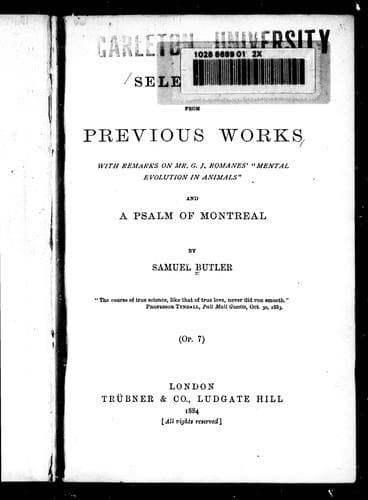
Selections from Previous Works: With Remarks on Romanes' Mental Evolution in Animals, and a Psalm of MontrealButler, Samuel
Philosophy
Selections from Previous Works: With Remarks on Romanes' Mental Evolution in Animals, and a Psalm of Montreal
Butler, Samuel
English literature -- 19th century -- Miscellanea; Romanes, George John, 1848-1894. Mental evolution in animals
All depends upon who it is that is lying. One man may steal a horse when
another may not look over a hedge. The good man who tells no lies
wittingly to himself and is never unkindly, may lie and lie and lie
whenever he chooses to other people, and he will not be false to any man:
his lies become truths as they pass into the hearers' ear. If a man
deceives himself and is unkind, the truth is not in him; it turns to
falsehood while yet in his mouth, like the quails in the Wilderness of
Sinai. How this is so or why, I know not, but that the Lord hath mercy
on whom He will have mercy and whom He willeth He hardeneth. My Italian
friends are doubtless in the main right about the priests, but there are
many exceptions, as they themselves gladly admit. For my own part I have
found the _curato_ in the small subalpine villages of North Italy to be
more often than not a kindly excellent man to whom I am attracted by
sympathies deeper than any mere superficial differences of opinion can
counteract. With monks, however, as a general rule, I am less able to
get on: nevertheless I have received much courtesy at the hands of some.
My young friend the novice was delightful--only it was so sad to think of
the future that is before him. He wanted to know all about England, and
when I told him it was an island, clasped his hands and said, "Oh che
Providenza!" He told me how the other young men of his own age plagued
him as he trudged his rounds high up among the most distant hamlets
begging alms for the poor. "Be a good fellow," they would say to him,
"drop all this nonsense and come back to us, and we will never plague you
again." Then he would turn upon them and put their words from him. Of
course my sympathies were with the other young men rather than with him,
but it was impossible not to be sorry for the manner in which he had been
humbugged from the day of his birth, till he was now incapable of seeing
things from any other standpoint than that of authority.
What he said to me about knowing that Handel was a Catholic by his music,
put me in mind of what another good Catholic once said to me about a
picture. He was a Frenchman and very nice, but a _devot_, and anxious to
convert me. He paid a few days' visit to London, so I showed him the
National Gallery. While there I pointed out to him Sebastian del
Piombo's picture of the raising of Lazarus as one of the supposed
masterpieces of our collection. He had the proper orthodox fit of
admiration over it, and then we went through the other rooms. After a
while we found ourselves before West's picture of "Christ healing the
Sick." My French friend did not, I suppose, examine it very carefully,
at any rate he believed he was again before the raising of Lazarus by
Sebastian del Piombo; he paused before it, and had his fit of admiration
over again: then turning to me he said, "Ah! you would understand this
picture better if you were a Catholic." I did not tell him of his
mistake.
Public-domain text, read in full here on John Shaqi.
Reviews
Reviews
No reviews yet
Be the first to share your thoughts on this work.
Elsewhere in the archive
Join the Discussion
Join the discussion
Sign in to leave a comment or review.
Sign InorCreate an account