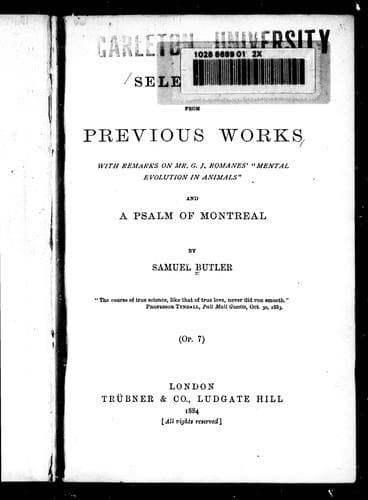
Selections from Previous Works: With Remarks on Romanes' Mental Evolution in Animals, and a Psalm of Montreal — John Shaqi
Selections from Previous Works: With Remarks on Romanes' Mental Evolution in Animals, and a Psalm of MontrealButler, Samuel
Philosophy
Selections from Previous Works: With Remarks on Romanes' Mental Evolution in Animals, and a Psalm of Montreal
Butler, Samuel
English literature -- 19th century -- Miscellanea; Romanes, George John, 1848-1894. Mental evolution in animals
Having made these last admissions, she returned to her original
statement, namely, that every one in the country really supported the
bank. As to the fewness of the people, and the absence of the
able-bodied, she pointed out to me with some justice that this was
exactly what we ought to expect. The men who were most conversant about
the stability of human institutions, such as the lawyers, men of science,
doctors, statesmen, painters, and the like, were just those who were most
likely to be misled by their own fancied accomplishments, and to be made
unduly suspicious by their licentious desire for greater present return,
which was at the root of nine-tenths of the opposition, by their vanity,
which would prompt them to affect superiority to the prejudices of the
vulgar, and by the stings of their own conscience, which was constantly
upbraiding them in the most cruel manner on account of their bodies,
which were generally diseased; let a person's intellect be never so
sound, unless his body were in absolute health, he could form no judgment
worth having on matters of this kind. The body was everything: it need
not perhaps be such a _strong_ body (she said this because she saw I was
thinking of the old and infirm-looking folks whom I had seen in the
bank), but it must be in perfect health; in this case, the less active
strength it had the more free would be the working of the intellect, and
therefore the sounder the conclusion. The people, then, whom I had seen
at the bank were in reality the very ones whose opinions were most worth
having; they declared its advantages to be incalculable, and even
professed to consider the immediate return to be far larger than they
were entitled to; and so she ran on, nor did she leave off till we had
got back to the house.
She might say what she pleased, but her manner was not one that carried
much conviction; and later on I saw signs of general indifference to
these banks that were not to be mistaken. Their supporters often denied
it, but the denial was generally so couched as to add another proof of
its existence. In commercial panics, and in times of general distress,
the people as a mass did not so much as even think of turning to these
banks. A few individuals might do so, some from habit and early
training, some from hope of gain, but few from a genuine belief that the
money was good; the masses turned instinctively to the other currency. In
a conversation with one of the musical bank managers I ventured to hint
this as plainly as politeness would allow. He said that it had been more
or less true till lately; but that now they had put fresh stained glass
windows into all the banks in the country, and repaired the buildings,
and enlarged the organs, and taken to talking nicely to the people in the
streets, and to remembering the ages of their children and giving them
things when they were ill, so that all would henceforth go smoothly.
Public-domain text, read in full here on John Shaqi.
Reviews
Reviews
No reviews yet
Be the first to share your thoughts on this work.
Join the Discussion
Join the discussion
Sign in to leave a comment or review.
Sign InorCreate an account