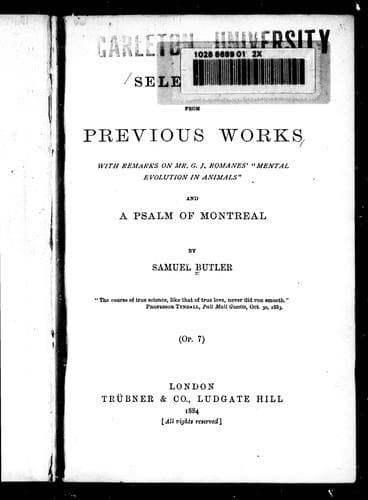
Selections from Previous Works: With Remarks on Romanes' Mental Evolution in Animals, and a Psalm of MontrealButler, Samuel
Philosophy
Selections from Previous Works: With Remarks on Romanes' Mental Evolution in Animals, and a Psalm of Montreal
Butler, Samuel
English literature -- 19th century -- Miscellanea; Romanes, George John, 1848-1894. Mental evolution in animals
After a couple of hours the houses became more rare; we got above the
sources of the chair-stream; bits of rough rock began to jut out from the
pasture; here and there the rhododendron began to shew itself by the
roadside; the chestnuts left off along a line as level as though cut with
a knife; stone-roofed _cascine_ began to abound, with goats and cattle
feeding near them; the booths of the religious trinket-mongers increased;
the blind, halt, and maimed became more importunate, and the
foot-passengers were more entirely composed of those whose object was, or
had been, a visit to the sanctuary itself. The numbers of these
pilgrims--generally in their Sunday's best, and often comprising the
greater part of a family--were so great, though there was no special
festa, as to testify to the popularity of the institution. They
generally walked barefoot, and carried their shoes and stockings; their
baggage consisted of a few spare clothes, a little food, and a pot or pan
or two to cook with. Many of them looked very tired, and had evidently
tramped from long distances--indeed, we saw costumes belonging to valleys
which could not be less than two or three days distant. They were almost
invariably quiet, respectable, and decently clad, sometimes a little
merry, but never noisy, and none of them tipsy. As we travelled along
the road, we must have fallen in with several hundreds of these pilgrims
coming and going; nor is this likely to be an extravagant estimate,
seeing that the hospice can make up more than five thousand beds. By
eleven we were at the sanctuary itself.
Fancy a quiet upland valley, the floor of which is about the same height
as the top of Snowdon, shut in by lofty mountains upon three sides, while
on the fourth the eye wanders at will over the plains below. Fancy
finding a level space in such a valley watered by a beautiful mountain
stream, and nearly filled by a pile of collegiate buildings, not less
important than those, we will say, of Trinity College, Cambridge. True,
Oropa is not in the least like Trinity, except that one of its courts is
large, grassy, has a chapel and a fountain in it, and rooms all round it;
but I do not know how better to give a rough description of Oropa than by
comparing it with one of our largest English colleges.
The buildings consist of two main courts. The first comprises a couple
of modern wings, connected by the magnificent facade of what is now the
second or inner court. This facade dates from about the middle of the
seventeenth century; its lowest storey is formed by an open colonnade,
and the whole stands upon a raised terrace from which a noble flight of
steps descends into the outer court.
Public-domain text, read in full here on John Shaqi.
Reviews
Reviews
No reviews yet
Be the first to share your thoughts on this work.
Elsewhere in the archive
Join the Discussion
Join the discussion
Sign in to leave a comment or review.
Sign InorCreate an account