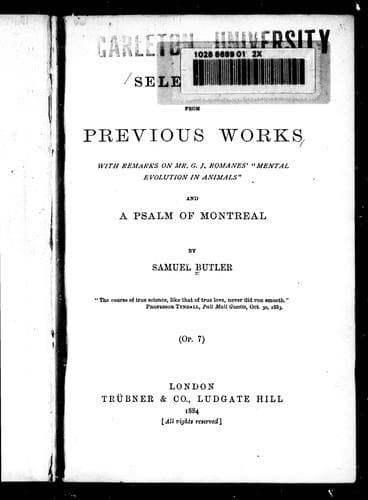
Selections from Previous Works: With Remarks on Romanes' Mental Evolution in Animals, and a Psalm of MontrealButler, Samuel
Philosophy
Selections from Previous Works: With Remarks on Romanes' Mental Evolution in Animals, and a Psalm of Montreal
Butler, Samuel
English literature -- 19th century -- Miscellanea; Romanes, George John, 1848-1894. Mental evolution in animals
SANCTUARIES OF OROPA AND GRAGLIA. (FROM CHAPTERS XV. AND XVI. OF ALPS
AND SANCTUARIES.)
The morning after our arrival at Biella, we took the daily diligence for
Oropa, leaving Biella at eight o'clock. Before we were clear of the town
we could see the long line of the hospice, and the chapels dotted about
near it, high up in a valley at some distance off; presently we were
shown another fine building some eight or nine miles away, which we were
told was the sanctuary of Graglia. About this time the pictures and
statuettes of the Madonna began to change their hue and to become
black--for the sacred image of Oropa being black, all the Madonnas in her
immediate neighbourhood are of the same complexion. Underneath some of
them is written, "Nigra sum sed sum formosa," which, as a rule, was more
true as regards the first epithet than the second.
It was not market-day, but streams of people were coming to the town.
Many of them were pilgrims returning from the sanctuary, but more were
bringing the produce of their farms or the work of their hands for sale.
We had to face a steady stream of chairs, which were coming to town in
baskets upon women's heads. Each basket contained twelve chairs, though
whether it is correct to say that the basket contained the chairs--when
the chairs were all, so to say, froth running over the top of the
basket--is a point I cannot settle. Certainly we had never seen anything
like so many chairs before, and felt almost as though we had surprised
nature in the laboratory wherefrom she turns out the chair-supply of the
world. The road continued through a succession of villages almost
running into one another for a long way after Biella was passed, but
everywhere we noticed the same air of busy thriving industry which we had
seen in Biella itself. We noted also that a preponderance of the people
had light hair, while that of the children was frequently nearly white,
as though the infusion of German blood was here stronger even than usual.
Though so thickly peopled, the country was of great beauty. Near at hand
were the most exquisite pastures close shaven after their second mowing,
gay with autumnal crocuses, and shaded with stately chestnuts; beyond
were rugged mountains, in a combe on one of which we saw Oropa itself now
gradually nearing; behind, and below, many villages, with vineyards and
terraces cultivated to the highest perfection; farther on, Biella already
distant, and beyond this a "big stare," as an American might say, over
the plains of Lombardy from Turin to Milan, with the Apennines from Genoa
to Bologna hemming the horizon. On the road immediately before us, we
still faced the same steady stream of chairs flowing ever Biella-ward.
Public-domain text, read in full here on John Shaqi.
Reviews
Reviews
No reviews yet
Be the first to share your thoughts on this work.
Elsewhere in the archive
Join the Discussion
Join the discussion
Sign in to leave a comment or review.
Sign InorCreate an account