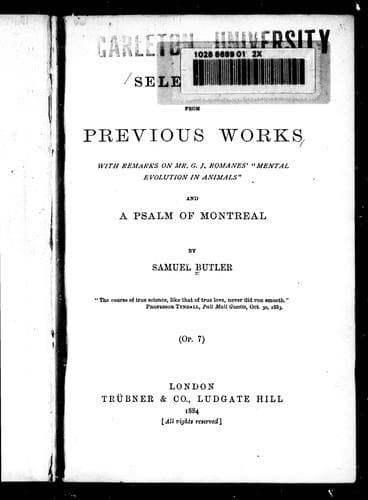
Selections from Previous Works: With Remarks on Romanes' Mental Evolution in Animals, and a Psalm of MontrealButler, Samuel
Philosophy
Selections from Previous Works: With Remarks on Romanes' Mental Evolution in Animals, and a Psalm of Montreal
Butler, Samuel
English literature -- 19th century -- Miscellanea; Romanes, George John, 1848-1894. Mental evolution in animals
As I have said, the founders of these Italian chapels aimed at realism.
Each chapel was intended as an illustration, and the desire was to bring
the whole scene more vividly before the faithful by combining the
picture, the statue, and the effect of a scene upon the stage in a single
work of art. The attempt would be an ambitious one though made once only
in a neighbourhood, but in most of the places in North Italy where
anything of the kind has been done, the people have not been content with
a single illustration; it has been their scheme to take a mountain as
though it had been a book or wall and cover it with illustrations. In
some cases--as at Orta, whose Sacro Monte is perhaps the most beautiful
of all as regards the site itself--the failure is complete, but in some
of the chapels at Varese and in many of those at Varallo, great works
have been produced which have not yet attracted as much attention as they
deserve. It may be doubted, indeed, whether there is a more remarkable
work of art in North Italy than the crucifixion chapel at Varallo, where
the twenty-five statues, as well as the frescoes behind them, are (with
the exception of the figure of Christ, which has been removed) by
Gaudenzio Ferrari. It is to be wished that some one of these
chapels--both chapel and sculptures--were reproduced at South Kensington.
Varallo, which is undoubtedly the most interesting sanctuary in North
Italy, has forty-four of these illustrative chapels; Varese, fifteen;
Orta, eighteen; and Oropa, seventeen. No one is allowed to enter them,
except when repairs are needed; but when these are going on, as is
constantly the case, it is curious to look through the grating into the
somewhat darkened interior, and to see a living figure or two among the
statues; a little motion on the part of a single figure seems to
communicate itself to the rest and make them all more animated. If the
living figure does not move much, it is easy at first to mistake it for a
terra-cotta one. At Orta, some years since, looking one evening into a
chapel when the light was fading, I was surprised to see a saint whom I
had not seen before; he had no glory except what shone from a very red
nose; he was smoking a short pipe, and was painting the Virgin Mary's
face. The touch was a finishing one, put on with deliberation, slowly,
so that it was two or three seconds before I discovered that the
interloper was no saint.
Public-domain text, read in full here on John Shaqi.
Reviews
Reviews
No reviews yet
Be the first to share your thoughts on this work.
Elsewhere in the archive
Join the Discussion
Join the discussion
Sign in to leave a comment or review.
Sign InorCreate an account