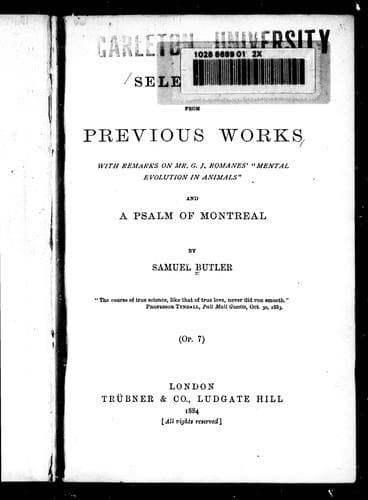
Selections from Previous Works: With Remarks on Romanes' Mental Evolution in Animals, and a Psalm of MontrealButler, Samuel
Philosophy
Selections from Previous Works: With Remarks on Romanes' Mental Evolution in Animals, and a Psalm of Montreal
Butler, Samuel
English literature -- 19th century -- Miscellanea; Romanes, George John, 1848-1894. Mental evolution in animals
The figures in the chapels at Oropa are not as good as the best of those
at Varallo, but some of them are very nice notwithstanding. We liked the
seventh chapel the best--the one which illustrates the sojourn of the
Virgin Mary in the Temple. It contains forty-four figures, and
represents the Virgin on the point of completing her education as head
girl at a high-toned academy for young gentlewomen. All the young ladies
are at work making mitres for the bishop, or working slippers in Berlin
wool for the new curate, but the Virgin sits on a dais above the others
on the same platform with the venerable lady-principal, who is having
passages read out to her from some standard Hebrew writer. The statues
are the work of a local sculptor, named Aureggio, who lived at the end of
the seventeenth and beginning of the eighteenth century.
The highest chapel must be a couple of hundred feet above the main
buildings, and from near it there is an excellent bird's-eye view of the
sanctuary and the small plain behind; descending on to this last, we
entered the quadrangle from the north-west side, and visited the chapel
in which the sacred image of the Madonna is contained. We did not see
the image itself, which is only exposed to public view on great
occasions. It is believed to have been carved by St. Luke the
Evangelist. It is said that at one time there was actually an
inscription on the image in Greek characters, of which the translation
is, "Eusebius. A token of respect and affection from his sincere friend,
Luke;" but this being written in chalk or pencil only, has been worn off,
and is known by tradition only. I must ask the reader to content himself
with the following account of it which I take from Marocco's work upon
Oropa:--
"That this statue of the Virgin is indeed by St. Luke is attested by
St. Eusebius, a man of eminent piety, and no less enlightened than
truthful, and the store which he set by it is proved by his shrinking
from no discomforts in his carriage of it from a distant country, and
by his anxiety to put it in a place of great security. His desire,
indeed, was to keep it in the spot which was most near and dear to
him, so that he might extract from it the higher incitement to
devotion, and more sensible comfort in the midst of his austerities
and apostolic labours.
Public-domain text, read in full here on John Shaqi.
Reviews
Reviews
No reviews yet
Be the first to share your thoughts on this work.
Elsewhere in the archive
Join the Discussion
Join the discussion
Sign in to leave a comment or review.
Sign InorCreate an account