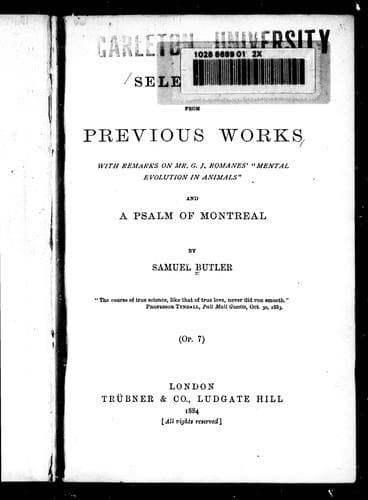
Selections from Previous Works: With Remarks on Romanes' Mental Evolution in Animals, and a Psalm of MontrealButler, Samuel
Philosophy
Selections from Previous Works: With Remarks on Romanes' Mental Evolution in Animals, and a Psalm of Montreal
Butler, Samuel
English literature -- 19th century -- Miscellanea; Romanes, George John, 1848-1894. Mental evolution in animals
"This truth is further confirmed by the quality of the wood from which
the statue is carved, which is commonly believed to be cedar; by the
Eastern character of the work; by the resemblance both of the
lineament and the colour to those of other statues by St. Luke; by the
tradition of the neighbourhood, which extends in an unbroken and well-
assured line to the time of St. Eusebius himself; by the miracles that
have been worked here by its presence, and elsewhere by its
invocation, or even by indirect contact with it; by the miracles,
lastly, which are inherent in the image itself, {311} and which endure
to this day, such as is its immunity from all worm and from the decay
which would naturally have occurred in it through time and damp--more
especially in the feet, through the rubbing of religious objects
against them.
* * * * *
"The authenticity of this image is so certainly and clearly
established, that all supposition to the contrary becomes inexplicable
and absurd. Such, for example, is a hypothesis that it should not be
attributed to the Evangelist, but to another Luke, also called
'Saint,' and a Florentine by birth. This painter lived in the
eleventh century--that is to say, about seven centuries after the
image of Oropa had been known and venerated! This is indeed an
anachronism.
"Other difficulties drawn either from the ancient discipline of the
Church or from St. Luke the Evangelist's profession, which was that of
a physician, vanish at once when it is borne in mind--firstly, that
the cult of holy images, and especially of that of the most blessed
Virgin, is of extreme antiquity in the Church, and of apostolic
origin, as is proved by ecclesiastical writers and monuments found in
the catacombs which date, as far back as the first century (see among
other authorities, Nicolas, La Vergine vivente nella Chiesa, lib. iii.
cap. iii. section 2); secondly, that as the medical profession does
not exclude that of artists, St. Luke may have been both artist and
physician; that he did actually handle both the brush and the scalpel
is established by respectable and very old traditions, to say nothing
of other arguments which can be found in impartial and learned writers
upon such matters."
I will only give one more extract. It runs:--
"In 1855 a celebrated Roman portrait-painter, after having carefully
inspected the image of the Virgin Mary at Oropa, declared it to be
certainly a work of the first century of our era." {313}
I once saw a common cheap china copy of this Madonna announced as to be
given away with two pounds of tea, in a shop near Hatton Garden.
Public-domain text, read in full here on John Shaqi.
Reviews
Reviews
No reviews yet
Be the first to share your thoughts on this work.
Elsewhere in the archive
Join the Discussion
Join the discussion
Sign in to leave a comment or review.
Sign InorCreate an account