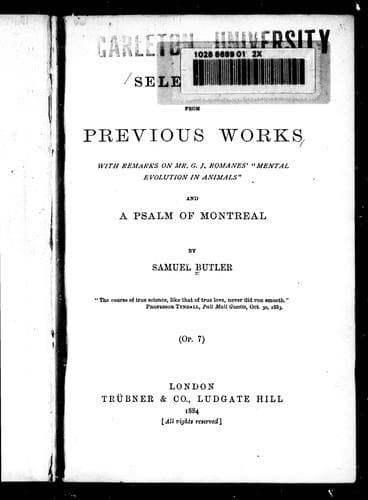
Selections from Previous Works: With Remarks on Romanes' Mental Evolution in Animals, and a Psalm of MontrealButler, Samuel
Philosophy
Selections from Previous Works: With Remarks on Romanes' Mental Evolution in Animals, and a Psalm of Montreal
Butler, Samuel
English literature -- 19th century -- Miscellanea; Romanes, George John, 1848-1894. Mental evolution in animals
He was accustomed to teach in a school for the poorest children every
Sunday afternoon, a task for which his patience and good temper well
fitted him. On one occasion, however, while he was explaining the effect
of baptism to one of his favourite pupils, he discovered to his great
surprise that the boy had never been baptized. He pushed his inquiries
further, and found that out of the fifteen boys in his class only five
had been baptized, and, not only so, but that no difference in
disposition or conduct could be discovered between the regenerate boys
and the unregenerate. The good and bad boys were distributed in
proportions equal to the respective numbers of the baptized and
unbaptized. In spite of a certain impetuosity of natural character, he
was also of a matter-of-fact and experimental turn of mind; he therefore
went through the whole school, which numbered about a hundred boys, and
found out who had been baptized and who had not. The same results
appeared. The majority had not been baptized; yet the good and bad
dispositions were so distributed as to preclude all possibility of
maintaining that the baptized boys were better than the unbaptized.
The reader may smile at the idea of any one's faith being troubled by a
fact of which the explanation is so obvious, but as a matter of fact my
brother was seriously and painfully shocked. The teacher to whom he
applied for a solution of the difficulty was not a man of any real power,
and reported my brother to the rector for having disturbed the school by
his inquiries. The rector was old and self-opinionated; the difficulty,
indeed, was plainly as new to him as it had been to my brother, but
instead of saying so at once, and referring to any recognised theological
authority, he tried to put him off with words which seemed intended to
silence him rather than to satisfy him; finally he lost his temper, and
my brother fell under suspicion of unorthodoxy.
This kind of treatment did not answer with my brother. He alludes to it
resentfully in the introductory chapter of his book. He became
suspicious that a preconceived opinion was being defended at the expense
of honest scrutiny, and was thus driven upon his own unaided
investigation. The result may be guessed: he began to go astray, and
strayed further and further. The children of God, he reasoned, the
members of Christ and inheritors of the kingdom of heaven, were no more
spiritually minded than the children of the world and the devil. Was
then the grace of God a gift which left no trace whatever upon those who
were possessed of it? A thing the presence or absence of which might be
ascertained by consulting the parish registry, but was not discernible in
conduct? The grace of man was more clearly perceptible than this.
Assuredly there must be a screw loose somewhere, which, for aught he
knew, might be jeopardising the salvation of all Christendom. Where then
was this loose screw to be found?
Public-domain text, read in full here on John Shaqi.
Reviews
Reviews
No reviews yet
Be the first to share your thoughts on this work.
Join the Discussion
Join the discussion
Sign in to leave a comment or review.
Sign InorCreate an account