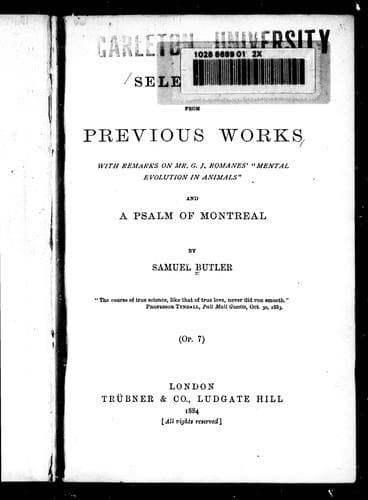
Selections from Previous Works: With Remarks on Romanes' Mental Evolution in Animals, and a Psalm of MontrealButler, Samuel
Philosophy
Selections from Previous Works: With Remarks on Romanes' Mental Evolution in Animals, and a Psalm of Montreal
Butler, Samuel
English literature -- 19th century -- Miscellanea; Romanes, George John, 1848-1894. Mental evolution in animals
"Sir James Hall hatched some chickens in an oven. Within a few minutes
after the shell was broken, a spider was turned loose before this very
youthful brood; the destroyer of flies had hardly proceeded more than a
few inches, before he was descried by one of these oven-born chickens,
and, at one peck of his bill, immediately devoured. This certainly was
not imitation. A female goat very near delivery died; Galen cut out the
young kid, and placed before it a bundle of hay, a bunch of fruit, and a
pan of milk; the young kid smelt to them all very attentively, and then
began to lap the milk. This was not imitation. And what is commonly and
rightly called instinct, cannot be explained away under the notion of its
being imitation." (Lecture xvii. on Moral Philosophy.)
It cannot, indeed, be explained away under the notion of its being
imitation, but I think it may well be so under that of its being memory.
Again, a little further on in the same lecture as that above quoted from,
we find:--
"Ants and beavers lay up magazines. Where do they get their knowledge
that it will not be so easy to collect food in rainy weather as it is in
summer? Men and women know these things, because their grandpapas and
grandmammas have told them so. Ants hatched from the egg artificially,
or birds hatched in this manner, have all this knowledge by intuition,
without the smallest communication with any of their relations. Now
observe what the solitary wasp does; she digs several holes in the sand,
in each of which she deposits an egg, though she certainly knows not (?)
that an animal is deposited in that egg, and still less that this animal
must be nourished with other animals. She collects a few green flies,
rolls them up neatly in several parcels (like Bologna sausages), and
stuffs one parcel into each hole where an egg is deposited. When the
wasp worm is hatched, it finds a store of provision ready made; and what
is most curious, the quantity allotted to each is exactly sufficient to
support it, till it attains the period of wasphood, and can provide for
itself. This instinct of the parent wasp is the more remarkable as it
does not feed upon flesh itself. Here the little creature has never seen
its parent; for by the time it is born, the parent is always eaten by
sparrows; and yet, without the slightest education, or previous
experience, it does everything that the parent did before it. Now the
objectors to the doctrine of instinct may say what they please, but young
tailors have no intuitive method of making pantaloons; a new-born mercer
cannot measure diaper; nature teaches a cook's daughter nothing about
sippets. All these things require with us seven years' apprenticeship;
but insects are like Moliere's persons of quality--they know everything
(as Moliere says) without having learnt anything. 'Les gens de qualite
savent tout, sans avoir rien appris.'"
Public-domain text, read in full here on John Shaqi.
Reviews
Reviews
No reviews yet
Be the first to share your thoughts on this work.
Elsewhere in the archive
Join the Discussion
Join the discussion
Sign in to leave a comment or review.
Sign InorCreate an account