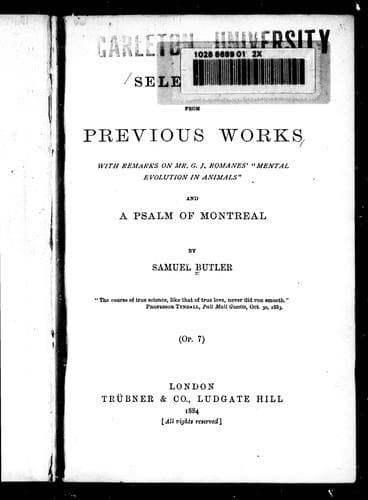
Selections from Previous Works: With Remarks on Romanes' Mental Evolution in Animals, and a Psalm of MontrealButler, Samuel
Philosophy
Selections from Previous Works: With Remarks on Romanes' Mental Evolution in Animals, and a Psalm of Montreal
Butler, Samuel
English literature -- 19th century -- Miscellanea; Romanes, George John, 1848-1894. Mental evolution in animals
How completely all difficulty vanishes from the facts so pleasantly told
in this passage when we bear in mind the true nature of personal
identity, the ordinary working of memory, and the vanishing tendency of
consciousness concerning what we know exceedingly well.
My last instance I take from M. Ribot, who writes:--"Gratiolet, in his
_Anatomie Comparee du Systems Nerveux_, states that an old piece of
wolf's skin, with the hair all worn away, when set before a little dog,
threw the animal into convulsions of fear by the slight scent attaching
to it. The dog had never seen a wolf, and we can only explain this alarm
by the hereditary transmission of certain sentiments, coupled with a
certain perception of the sense of smell." ("Heredity," p. 43.)
I should prefer to say "we can only explain the alarm by supposing that
the smell of the wolf's skin"--the sense of smell being, as we all know,
more powerful to recall the ideas that have been associated with it than
any other sense--"brought up the ideas with which it had been associated
in the dog's mind during many previous existences"--he on smelling the
wolf's skin remembering all about wolves perfectly well.
CONCLUDING REMARKS. (FROM CHAPTER XV. OF LIFE AND HABIT.)
Here, then, I leave my case, though well aware that I have crossed the
threshold only of my subject. My work is of a tentative character, put
before the public as a sketch or design for a, possibly, further
endeavour, in which I hope to derive assistance from the criticisms which
this present volume may elicit. {125} Such as it is, however, for the
present I must leave it.
We have seen that we cannot do anything thoroughly till we can do it
unconsciously, and that we cannot do anything unconsciously till we can
do it thoroughly; this at first seems illogical; but logic and
consistency are luxuries for the gods, and the lower animals, only. Thus
a boy cannot really know how to swim till he can swim, but he cannot swim
till he knows how to swim. Conscious effort is but the process of
rubbing off the rough corners from these two contradictory statements,
till they eventually fit into one another so closely that it is
impossible to disjoin them.
Whenever we see any creature able to go through any complicated and
difficult process with little or no effort--whether it be a bird building
her nest, or a hen's egg making itself into a chicken, or an ovum turning
itself into a baby--we may conclude that the creature has done the same
thing on a very great number of past occasions.
We found the phenomena exhibited by heredity to be so like those of
memory, and to be so inexplicable on any other supposition than that they
were modes of memory, that it was easier to suppose them due to memory in
spite of the fact that we cannot remember having recollected, than to
believe that because we cannot so remember, therefore the phenomena
cannot be due to memory.
Public-domain text, read in full here on John Shaqi.
Reviews
Reviews
No reviews yet
Be the first to share your thoughts on this work.
Elsewhere in the archive
Join the Discussion
Join the discussion
Sign in to leave a comment or review.
Sign InorCreate an account