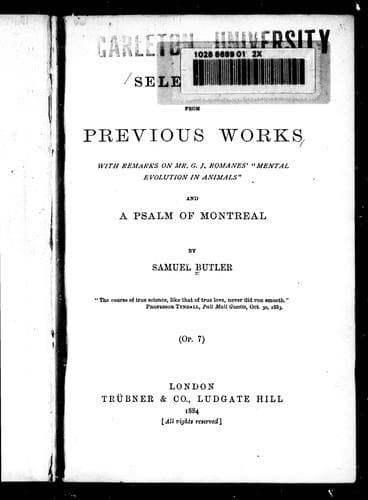
Selections from Previous Works: With Remarks on Romanes' Mental Evolution in Animals, and a Psalm of MontrealButler, Samuel
Philosophy
Selections from Previous Works: With Remarks on Romanes' Mental Evolution in Animals, and a Psalm of Montreal
Butler, Samuel
English literature -- 19th century -- Miscellanea; Romanes, George John, 1848-1894. Mental evolution in animals
Life then is the being possessed of memory. We are all the same stuff to
start with; plants and animals only differ from one another because they
remember different things; they grow up in the shapes they bear because
these shapes are the embodiments of their ideas concerning their own past
history; they are forms of faith or faiths of form whichever the reader
chooses.
Hence the term "Natural History," as applied to the different plants and
animals around us. For surely the study of natural history means only
the study of plants and animals themselves, which, at the moment of using
the words "Natural History," we assume to be the most important part of
nature.
A living creature well supported by a mass of healthy ancestral memory is
a young and growing creature, free from ache or pain, and thoroughly
acquainted with its business so far, but with much yet to be reminded of.
A creature which finds itself and its surroundings not so unlike those of
its parents about the time of their begetting it, as to be compelled to
recognise that it never yet was in any such position, is a creature in
the heyday of life. A creature which begins to be aware of itself is one
which is beginning to recognise that the situation is a new one.
It is the young and fair, then, who are the truly old and truly
experienced; it is they who alone have a trustworthy memory to guide
them; they alone know things as they are, and it is from them that, as we
grow older, we must study if we would still cling to truth. The whole
charm of youth lies in its advantage over age in respect of experience,
and where this has for some reason failed, or been misapplied, the charm
is broken. When we say that we are getting old, we should say rather
that we are getting new or young, and are suffering from inexperience,
which drives us into doing things which we do not understand, and lands
us, eventually, in the utter impotence of death. The kingdom of heaven
is the kingdom of little children.
SELECTIONS FROM EVOLUTION, OLD AND NEW. {131}
IMPOTENCE OF PALEY'S CONCLUSION. THE TELEOLOGY OF THE EVOLUTIONIST.
(FROM CHAPTER III. OF EVOLUTION, OLD AND NEW.)
Public-domain text, read in full here on John Shaqi.
Reviews
Reviews
No reviews yet
Be the first to share your thoughts on this work.
Elsewhere in the archive
Join the Discussion
Join the discussion
Sign in to leave a comment or review.
Sign InorCreate an account