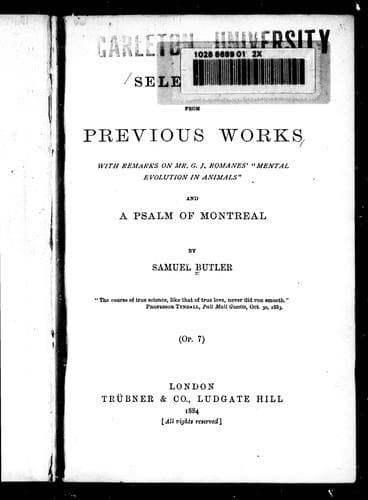
Selections from Previous Works: With Remarks on Romanes' Mental Evolution in Animals, and a Psalm of MontrealButler, Samuel
Philosophy
Selections from Previous Works: With Remarks on Romanes' Mental Evolution in Animals, and a Psalm of Montreal
Butler, Samuel
English literature -- 19th century -- Miscellanea; Romanes, George John, 1848-1894. Mental evolution in animals
We then inquired what was the great principle underlying variation, and
answered, with Lamarck, that it must be "sense of need;" and though not
without being haunted by suspicion of a vicious circle, and also well
aware that we were not much nearer the origin of life than when we
started, we still concluded that here was the truest origin of species,
and hence of genera; and that the accumulation of variations, which in
time amounted to specific and generic differences, was due to
intelligence and memory on the part of the creature varying, rather than
to the operation of what Mr. Darwin has called "natural selection." At
the same time we admitted that the course of nature is very much as Mr.
Darwin has represented it, in this respect, in so far as that there is a
struggle for existence, and that the weaker must go to the wall. But we
denied that this part of the course of nature would lead to much, if any,
accumulation of variation, unless the variation was directed mainly by
intelligent sense of need, with continued personality and memory.
We conclude, therefore, that the small, apparently structureless,
impregnate ovum from which we have each one of us sprung, has a potential
recollection of all that has happened to each one of its ancestors prior
to the period at which any such ancestor has issued from the bodies of
its progenitors--provided, that is to say, a sufficiently deep, or
sufficiently often-repeated, impression has been made to admit of its
being remembered at all.
Each step of normal development will lead the impregnate ovum up to, and
remind it of, its next ordinary course of action, in the same way as we,
when we recite a well-known passage, are led up to each successive
sentence by the sentence which has immediately preceded it.
And for this reason, namely, that as it takes two people "to tell" a
thing--a speaker and a comprehending listener, without which last, though
much may have been said, there has been nothing told--so also it takes
two people, as it were, to "remember" a thing--the creature remembering,
and the surroundings of the creature at the time it last remembered.
Hence, though the ovum immediately after impregnation is instinct with
all the memories of both parents, not one of these memories can normally
become active till both the ovum itself, and its surroundings, are
sufficiently like what they respectively were, when the occurrence now to
be remembered last took place. The memory will then immediately return,
and the creature will do as it did on the last occasion that it was in
like case as now. This ensures that similarity of order shall be
preserved in all the stages of development in successive generations.
Public-domain text, read in full here on John Shaqi.
Reviews
Reviews
No reviews yet
Be the first to share your thoughts on this work.
Elsewhere in the archive
Join the Discussion
Join the discussion
Sign in to leave a comment or review.
Sign InorCreate an account