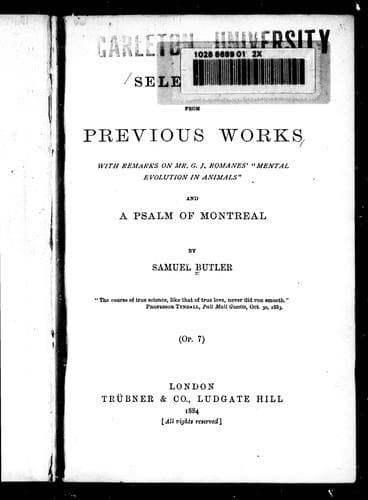
Selections from Previous Works: With Remarks on Romanes' Mental Evolution in Animals, and a Psalm of MontrealButler, Samuel
Philosophy
Selections from Previous Works: With Remarks on Romanes' Mental Evolution in Animals, and a Psalm of Montreal
Butler, Samuel
English literature -- 19th century -- Miscellanea; Romanes, George John, 1848-1894. Mental evolution in animals
Writing of the successive changes through which each embryo is forced to
pass, the late Mr. G. H. Lewes says that "none of these phases have any
adaptation to the future state of the animal, but are in positive
contradiction to it or are simply purposeless; whereas all show stamped
on them the unmistakable characters of _ancestral_ adaptation, and the
progressions of organic evolution. What does the fact imply? There is
not a single known example of a complex organism which is not developed
out of simpler forms. Before it can attain the complex structure which
distinguishes it, there must be an evolution of forms similar to those
which distinguish the structure of organisms lower in the series. On the
hypothesis of a plan which prearranged the organic world, nothing could
be more unworthy of a supreme intelligence than this inability to
construct an organism at once, without making several previous tentative
efforts, undoing to-day what was so carefully done yesterday, and
_repeating for centuries the same tentatives in the same succession_. Do
not let us blink this consideration. There is a traditional phrase much
in vogue among the anthropomorphists, which arose naturally enough from a
tendency to take human methods as an explanation of the Divine--a phrase
which becomes a sort of argument--'The Great Architect.' But if we are
to admit the human point of view, a glance at the facts of embryology
must produce very uncomfortable reflections. For what should we say to
an architect who was unable, or being able was obstinately unwilling, to
erect a palace except by first using his materials in the shape of a hut,
then pulling them down and rebuilding them as a cottage, then adding
story to story and room to room, _not_ with any reference to the ultimate
purposes of the palace, but wholly with reference to the way in which
houses were constructed in ancient times? What should we say to the
architect who could not form a museum out of bricks and mortar, but was
forced to begin as if going to construct a mansion, and after proceeding
some way in this direction, altered his plan into a palace, and that
again into a museum? Yet this is the sort of succession on which
organisms are constructed. The fact has long been familiar; how has it
been reconciled with infinite wisdom? Let the following passage answer
for a thousand:--'The embryo is nothing like the miniature of the adult.
For a long while the body in its entirety and in its details, presents
the strangest of spectacles. Day by day and hour by hour, the aspect of
the scene changes, and this instability is exhibited by the most
essential parts no less than by the accessory parts. One would say that
nature feels her way, and only reaches the goal after many times missing
the path' (on dirait que la nature tatonne et ne conduit son oeuvre a bon
fin, qu'apres s'etre souvent trompee)." {134a}
Public-domain text, read in full here on John Shaqi.
Reviews
Reviews
No reviews yet
Be the first to share your thoughts on this work.
Elsewhere in the archive
Join the Discussion
Join the discussion
Sign in to leave a comment or review.
Sign InorCreate an account