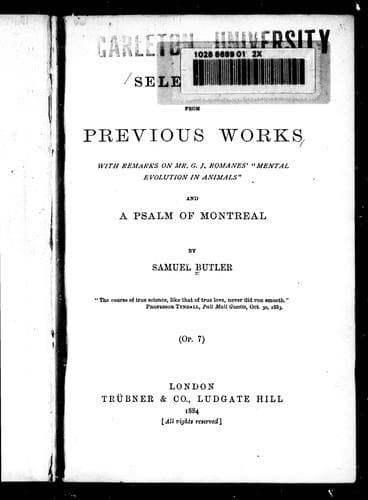
Selections from Previous Works: With Remarks on Romanes' Mental Evolution in Animals, and a Psalm of MontrealButler, Samuel
Philosophy
Selections from Previous Works: With Remarks on Romanes' Mental Evolution in Animals, and a Psalm of Montreal
Butler, Samuel
English literature -- 19th century -- Miscellanea; Romanes, George John, 1848-1894. Mental evolution in animals
The above passage does not, I think, affect the evidence for design which
we adduced in the preceding chapter. {134b} However strange the process
of manufacture may appear, when the work comes to be turned out the
design is too manifest to be doubted.
If the reader were to come upon some lawyer's deed which dealt with
matters of such unspeakable intricacy that it baffled his imagination to
conceive how it could ever have been drafted, and if in spite of this he
were to find the intricacy of the provisions to be made, exceeded only by
the ease and simplicity with which the deed providing for them was found
to work in practice; and after this, if he were to discover that the
deed, by whomsoever drawn, had nevertheless been drafted upon principles
which at first seemed very foreign to any according to which he was in
the habit of drafting deeds himself, as for example, that the draftsman
had begun to draft a will as a marriage settlement, and so forth--yet an
observer would not, I take it, do either of two things. He would not in
the face of the result deny the design, making himself judge rather of
the method of procedure than of the achievement. Nor yet after insisting
in the manner of Paley, on the wonderful proofs of intention and on the
exquisite provisions which were to be found in every syllable--thus
leading us up to the highest pitch of expectation--would he present us
with such an impotent conclusion as that the designer, though a living
person and a true designer, was yet immaterial and intangible, a
something, in fact, which proves to be a nothing; an omniscient and
omnipotent vacuum.
Our observer would feel he need not have been at such pains to establish
his design if this was to be the upshot of his reasoning. He would
therefore admit the design, and by consequence the designer, but would
probably ask a little time for reflection before he ventured to say who,
or what, or where the designer was. Then gaining some insight into the
manner in which the deed had been drawn, he would conclude that the
draftsman was a specialist who had had long practice in this particular
kind of work, but who now worked almost as it might be said automatically
and without consciousness, and found it difficult to depart from a
habitual method of procedure.
Public-domain text, read in full here on John Shaqi.
Reviews
Reviews
No reviews yet
Be the first to share your thoughts on this work.
Elsewhere in the archive
Join the Discussion
Join the discussion
Sign in to leave a comment or review.
Sign InorCreate an account