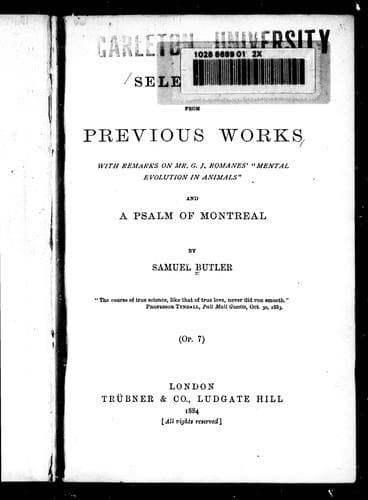
Selections from Previous Works: With Remarks on Romanes' Mental Evolution in Animals, and a Psalm of MontrealButler, Samuel
Philosophy
Selections from Previous Works: With Remarks on Romanes' Mental Evolution in Animals, and a Psalm of Montreal
Butler, Samuel
English literature -- 19th century -- Miscellanea; Romanes, George John, 1848-1894. Mental evolution in animals
Not man, the individual of any given generation, but man in the entirety
of his existence from the dawn of life onwards to the present moment. In
like manner we say that the designer of all organisms is so incorporate
with the organisms themselves--so lives, moves, and has its being in
those organisms, and is so one with them--they in it, and it in them--that
it is more consistent with reason and the common use of words to see the
designer of each living form in the living form itself, than to look for
its designer in some other place or person.
Thus we have a third alternative presented to us.
Mr. Charles Darwin and his followers deny design, as having any
appreciable share in the formation of organism at all.
Paley and the theologians insist on design, but upon a designer outside
the universe and the organism.
The third opinion is that suggested in the first instance and carried out
to a very high degree of development by Buffon. It was improved, and
indeed, made almost perfect by Dr. Erasmus Darwin, but too much neglected
by him after he had put it forward. It was borrowed, as I think we may
say with some confidence, from Dr. Darwin by Lamarck, and was followed up
by him ardently thenceforth, during the remainder of his life, though
somewhat less perfectly comprehended by him than it had been by Dr.
Darwin. It is that the design which has designed organisms, has resided
within, and been embodied in, the organisms themselves.
FAILURE OF THE FIRST EVOLUTIONISTS TO SEE THEIR POSITION AS TELEOLOGICAL.
(CHAPTER IV. OF EVOLUTION, OLD AND NEW.)
It follows from the doctrine of Dr. Erasmus Darwin and Lamarck, if not
from that of Buffon himself, that the majority of organs are as purposive
to the evolutionist as to the theologian, and far more intelligibly so.
Circumstances, however, prevented these writers from acknowledging this
fact to the world, and perhaps even to themselves. Their _crux_ was, as
it still is to so many evolutionists, the presence of rudimentary organs,
and the processes of embryological development. They would not admit
that rudimentary and therefore useless organs were designed by a Creator
to take their place once and for ever as part of a scheme whose main idea
was, that every animal structure was to serve some useful end in
connection with its possessor.
Public-domain text, read in full here on John Shaqi.
Reviews
Reviews
No reviews yet
Be the first to share your thoughts on this work.
Elsewhere in the archive
Join the Discussion
Join the discussion
Sign in to leave a comment or review.
Sign InorCreate an account