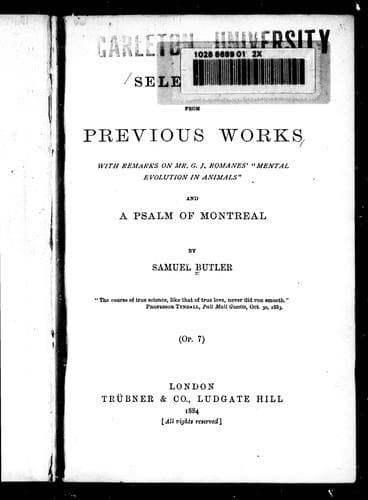
Selections from Previous Works: With Remarks on Romanes' Mental Evolution in Animals, and a Psalm of MontrealButler, Samuel
Philosophy
Selections from Previous Works: With Remarks on Romanes' Mental Evolution in Animals, and a Psalm of Montreal
Butler, Samuel
English literature -- 19th century -- Miscellanea; Romanes, George John, 1848-1894. Mental evolution in animals
This was the doctrine of final causes as then commonly held; in the face
of rudimentary organs it was absurd. Buffon was above all things else a
plain matter of fact thinker, who refused to go far beyond the obvious.
Like all other profound writers, he was, if I may say so, profoundly
superficial. He felt that the aim of research does not consist in the
knowing this or that, but in the easing of the desire to know or
understand more completely--in the peace of mind which passeth all
understanding. His was the perfection of a healthy mental organism by
which over effort is felt to be as vicious and contemptible as indolence.
He knew this too well to know the grounds of his knowledge, but we
smaller people who know it less completely, can see that such felicitous
instinctive tempering together of the two great contradictory principles,
love of effort and love of ease, has underlain every healthy step of all
healthy growth, whether of vegetable or animal, from the earliest
conceivable time to the present moment. Nothing is worth looking at
which is seen either too obviously or with too much difficulty. Nothing
is worth doing or well done which is not done fairly easily, and some
little deficiency of effort is more pardonable than any very perceptible
excess, for virtue has ever erred on the side of self-indulgence rather
than of asceticism.
According to Buffon, then--as also according to Dr. Darwin, who was just
such another practical and genial thinker, and who was distinctly a pupil
of Buffon, though a most intelligent and original one--if an organ after
a reasonable amount of inspection appeared to be useless, it was to be
called useless without more ado, and theories were to be ordered out of
court if they were troublesome. In like manner, if animals breed freely
_inter se_ before our eyes, as for example the horse and ass, the fact
was to be noted, but no animals were to be classed as capable of
interbreeding until they had asserted their right to such classification
by breeding with tolerable certainty. If, again, an animal looked as if
it felt, that is to say, if it moved about pretty quickly or made a
noise, it must be held to feel; if it did neither of these things it did
not look as if it felt, and therefore it must be said not to feel. _De
non apparentibus et non existentibus eadem est lex_ was one of the chief
axioms of their philosophy; no writers have had a greater horror of
mystery or of ideas that have not become so mastered as to be, or to have
been, superficial. Lamarck was one of those men of whom I believe it has
been said that they have brain upon the brain. He had his theory that an
animal could not feel unless it had a nervous system, and at least a
spinal marrow--and that it could not think at all without a brain--all
his facts, therefore, have to be made to square with this. With Buffon
and Dr. Darwin we feel safe that however wrong they may sometimes be,
Public-domain text, read in full here on John Shaqi.
Reviews
Reviews
No reviews yet
Be the first to share your thoughts on this work.
Elsewhere in the archive
Join the Discussion
Join the discussion
Sign in to leave a comment or review.
Sign InorCreate an account