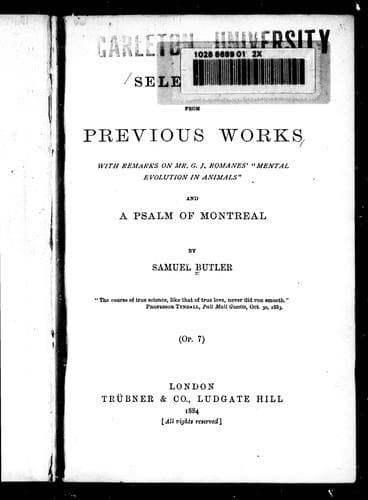
Selections from Previous Works: With Remarks on Romanes' Mental Evolution in Animals, and a Psalm of MontrealButler, Samuel
Philosophy
Selections from Previous Works: With Remarks on Romanes' Mental Evolution in Animals, and a Psalm of Montreal
Butler, Samuel
English literature -- 19th century -- Miscellanea; Romanes, George John, 1848-1894. Mental evolution in animals
their conclusions have always been arrived at on that fairly superficial
view of things in which, as I have elsewhere said, our nature alone
permits us to be comforted.
To these writers, then, the doctrine of final causes for rudimentary
organs was a piece of mystification and an absurdity; no less fatal to
any such doctrine were the processes of embryological development. It
was plain that the commonly received teleology must be given up; but the
idea of design or purpose was so associated in their minds with
theological design that they avoided it altogether. They seem to have
forgotten that an internal purpose is as much purpose as an external one;
hence, unfortunately, though their whole theory of development is
intensely purposive, it is the fact rather than the name of teleology
which has hitherto been insisted upon, even by the greatest writers on
evolution--the name having been most persistently denied even by those
who were most insisting on the thing itself.
It is easy to understand the difficulty felt by the fathers of evolution
when we remember how much had to be seen before the facts could lie well
before them. It was necessary to attain, firstly, to a perception of the
unity of person between parents and offspring in successive generations;
secondly, it must be seen that an organism's memory (within the
limitations to which all memory is subject) goes back for generations
beyond its birth, to the first beginnings in fact, of which we know
anything whatever; thirdly, the latency of that memory, as of memory
generally, till the associated ideas are reproduced, must be brought to
bear upon the facts of heredity; and lastly, the unconsciousness with
which habitual actions come to be performed, must be assigned as the
explanation of the unconsciousness with which we grow and discharge most
of our natural functions.
Buffon was too busy with the fact that animals descended with
modification at all, to go beyond the development and illustration of
this great truth. I doubt whether he ever saw more than the first, and
that dimly, of the four considerations above stated.
Dr. Darwin was the first to point out the first two considerations; he
did so with some clearness, but can hardly be said to have understood
their full importance: the two latter ideas do not appear to have
occurred to him.
Lamarck had little if any perception of any one of the four. When,
however, they are firmly seized and brought into their due bearings one
upon another, the facts of heredity become as simple as those of a man
making a tobacco pipe, and rudimentary organs are seen to be essentially
of the same character as the little rudimentary protuberance at the
bottom of the pipe to which I referred in 'Erewhon.' {141}
Public-domain text, read in full here on John Shaqi.
Reviews
Reviews
No reviews yet
Be the first to share your thoughts on this work.
Elsewhere in the archive
Join the Discussion
Join the discussion
Sign in to leave a comment or review.
Sign InorCreate an account