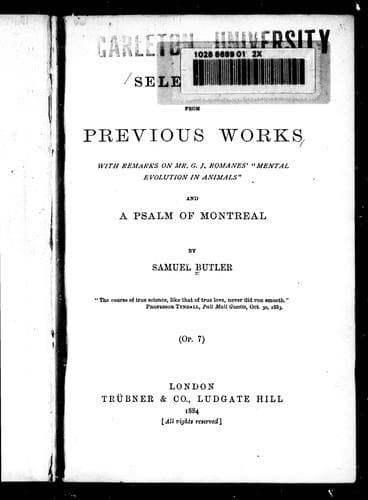
Selections from Previous Works: With Remarks on Romanes' Mental Evolution in Animals, and a Psalm of MontrealButler, Samuel
Philosophy
Selections from Previous Works: With Remarks on Romanes' Mental Evolution in Animals, and a Psalm of Montreal
Butler, Samuel
English literature -- 19th century -- Miscellanea; Romanes, George John, 1848-1894. Mental evolution in animals
It was reserved for Mr. Charles Darwin and for those who have too rashly
followed him to deny purpose as having had any share in the development
of animal and vegetable organs; to see no evidence of design in those
wonderful provisions which have been the marvel and delight of observers
in all ages. The one who has drawn our attention more than perhaps any
other living writer to those very marvels of co-adaptation, is the
foremost to maintain that they are the result not of desire and design,
either within the creature or without it, but of blind chance, working no
whither, and due but to the accumulation of innumerable lucky accidents.
"There are men," writes Professor Tyndal in the _Nineteenth Century_ for
last November, {144} "and by no means the minority, who, however wealthy
in regard to facts, can never rise into the region of principles; and
they are sometimes intolerant of those that can. They are formed to plod
meritoriously on in the lower levels of thought; unpossessed of the
pinions necessary to reach the heights, they cannot realise the mental
act--the act of inspiration it might well be called--by which a man of
genius, after long pondering and proving, reaches a theoretic conception
which unravels and illuminates the tangle of centuries of observation and
experiment. There are minds, it may be said in passing, who, at the
present moment, stand in this relation to Mr. Darwin."
The more rhapsodical parts of the above must go for what they are worth,
but I should be sorry to think that what remains conveyed a censure which
might fall justly on myself. As I read the earlier part of the passage I
confess that I imagined the conclusion was going to be very different
from what it proved to be. Fresh from the study of the older men and
also of Mr. Darwin himself, I failed to see that Mr. Darwin had
"unravelled and illuminated" a tangled skein, but believed him, on the
contrary, to have tangled and obscured what his predecessors had made in
great part, if not wholly, plain. With the older writers, I had felt as
though in the hands of men who wished to understand themselves and to
make their reader understand them with the smallest possible exertion.
The older men, if not in full daylight, at any rate saw in what quarter
of the sky the dawn was breaking, and were looking steadily towards it.
It is not they who have put their hands over their own eyes and ours, and
who are crying out that there is no light, but chance and blindness
everywhere.
THE TELEOLOGICAL EVOLUTION OF ORGANISM. (CHAPTER V. OF EVOLUTION, OLD
AND NEW.)
Public-domain text, read in full here on John Shaqi.
Reviews
Reviews
No reviews yet
Be the first to share your thoughts on this work.
Elsewhere in the archive
Join the Discussion
Join the discussion
Sign in to leave a comment or review.
Sign InorCreate an account