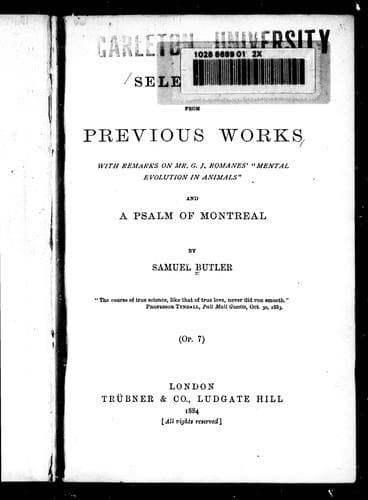
Selections from Previous Works: With Remarks on Romanes' Mental Evolution in Animals, and a Psalm of MontrealButler, Samuel
Philosophy
Selections from Previous Works: With Remarks on Romanes' Mental Evolution in Animals, and a Psalm of Montreal
Butler, Samuel
English literature -- 19th century -- Miscellanea; Romanes, George John, 1848-1894. Mental evolution in animals
I have stated the foregoing in what I take to be an extreme logical
development, in order that the reader may more easily perceive the
consequences of those premises which I am endeavouring to re-establish.
But it must not be supposed that an animal or plant has ever conceived
the idea of some organ widely different from any it was yet possessed of,
and has set itself to design it in detail and grow towards it.
The small jelly-speck, which we call the amoeba, has no organs save what
it can extemporise as occasion arises. If it wants to get at anything,
it thrusts out part of its jelly, which thus serves it as an arm or hand:
when the arm has served its purpose, it is absorbed into the rest of the
jelly, and has now to do the duty of a stomach by helping to wrap up what
it has just purveyed. The small round jelly-speck spreads itself out and
envelops its food, so that the whole creature is now a stomach, and
nothing but a stomach. Having digested its food, it again becomes a
jelly-speck, and is again ready to turn part of itself into hand or foot
as its next convenience may dictate. It is not to be believed that such
a creature as this, which is probably just sensitive to light and nothing
more, should be able to form any conception of an eye and set itself to
work to grow one, any more than it is believable that he who first
observed the magnifying power of a dew-drop, or even he who first
constructed a rude lens, should have had any idea in his mind of Lord
Rosse's telescope with all its parts and appliances. Nothing could be
well conceived more foreign to experience and common sense. Animals and
plants have travelled to their present forms as a man has travelled to
any one of his own most complicated inventions. Slowly, step by step,
through many blunders and mischances which have worked together for good
to those that have persevered in elasticity. They have travelled as man
has travelled, with but little perception of a want till there was also
some perception of a power, and with but little perception of a power
till there was a dim sense of want; want stimulating power, and power
stimulating want; and both so based upon each other that no one can say
which is the true foundation, but rather that they must be both baseless
and, as it were, meteoric in mid air. They have seen very little ahead
of a present power or need, and have been then most moral, when most
inclined to pierce a little into futurity, but also when most obstinately
declining to pierce too far, and busy mainly with the present. They have
been so far blindfolded that they could see but for a few steps in front
of them, yet so far free to see that those steps were taken with aim and
definitely, and not in the dark.
Public-domain text, read in full here on John Shaqi.
Reviews
Reviews
No reviews yet
Be the first to share your thoughts on this work.
Elsewhere in the archive
Join the Discussion
Join the discussion
Sign in to leave a comment or review.
Sign InorCreate an account