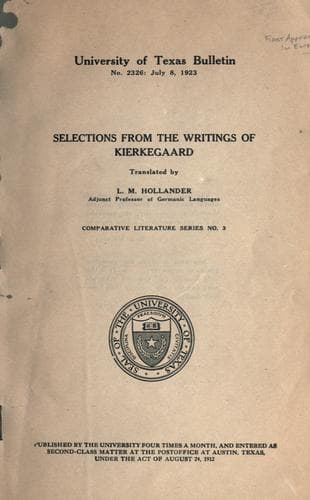
Selections from the Writings of KierkegaardKierkegaard, Søren
Religion
Selections from the Writings of Kierkegaard
Kierkegaard, Søren
Philosophy; Theology
Through the urging of his faith Abraham left the land of his
forefathers and became a stranger in the land of promise. Ke left
one thing behind and took one thing along: he left his worldly
wisdom behind and took with him faith. For else he would not have
left the land of his fathers, but would have thought it an unreasonable
demand. Through his faith he came to be a stranger in the land of
promise, where there was nothing to remind him of all that had been
dear to him, but where everything by its newness tempted his soul
to longing. And yet was he God's chosen, he in whom the Lord was
well pleased! Indeed, had he been one cast off, one thrust out of
God's mercy, then might he have comprehended it; but now it seemed
like a mockery of him and of his faith. There have been others who
lived in exile from the fatherland which they loved. They are not
forgotten, nor is the song of lament forgotten in which they
mournfully sought and found what they had lost. Of Abraham there
exists no song of lamentation. It is human to complain, it is
human to weep with the weeping; but it is greater to believe, and
more blessed to consider him who has faith.
Through his faith Abraham received the promise that in his seed
were to be blessed all races of mankind. Time passed, there was
still the possibility of it, and Abraham had faith. Another man
there was who also lived in hopes. Time passed, the evening of
his life was approaching; neither was he paltry enough to have
forgotten his hopes: neither shall he be forgotten by us! Then
he sorrowed, and his sorrow did not deceive him, as life had
done, but gave him all it could; for in the sweetness of sorrow
he became possessed of his disappointed hopes. It is human to
sorrow, it is human to sorrow with the sorrowing; but it is
greater to have faith, and more blessed to consider him who
has faith.
No song of lamentation has come down to us from Abraham. He did
not sadly count the days as time passed; he did not look at
Sarah with suspicious eyes, whether she was becoming old; he
did not stop the sun's course lest Sarah should grow old and
his hope with her; he did not lull her with his songs of lamentation.
Abraham grew old, and Sarah became a laughing-stock to the people;
and yet was he God's chosen, and heir to the promise that in his
seed were to be blessed all races of mankind. Were it, then,
not better if he had not been God's chosen? For what is it to
be God's chosen? Is it to have denied to one in one's youth all
the wishes of youth in order to have them fulfilled after great
labor in old age?
Public-domain text, read in full here on John Shaqi.
Reviews
Reviews
No reviews yet
Be the first to share your thoughts on this work.
Elsewhere in the archive
Join the Discussion
Join the discussion
Sign in to leave a comment or review.
Sign InorCreate an account