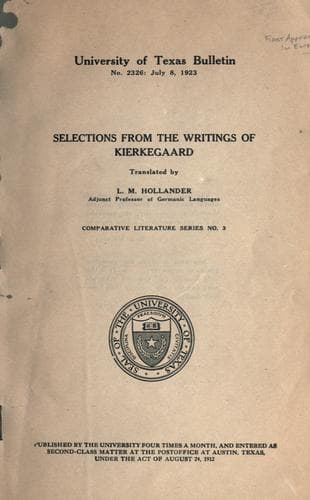
Selections from the Writings of KierkegaardKierkegaard, Søren
Religion
Selections from the Writings of Kierkegaard
Kierkegaard, Søren
Philosophy; Theology
The poet is the genius of memory, and does nothing but recall
what has been done, can do nothing but admire what has been
done. He adds nothing of his own, but he is jealous of what
has been entrusted to him. He obeys the choice of his own heart;
but once he has found what he has been seeking, he visits every
man's door with his song and with his speech, so that all may
admire the hero as he does, and be proud of the hero as he is.
This is his achievement, his humble work, this is his faithful
service in the house of the hero. If thus, faithful to his love,
he battles day and night against the guile of oblivion which
wishes to lure the hero from him, then has he accomplished his
task, then is he gathered to his hero who loves him as faithfully;
for the poet is at it were the hero's better self, unsubstantial,
to be sure, like a mere memory, but also transfigured as is a
memory. Therefore shall no one be forgotten who has done great
deeds; and even if there be delay, even if the cloud of misunderstanding
obscure the hero from our vision, still his lover will come some
time; and the more time has passed, the more faithfully will he
cleave to him.
No, no one shall be forgotten who was great in this world. But
each hero was great in his own way, and each one was eminent in
proportion to the great things he loved. For he who loved himself
became great through himself, and he who loved others became great
through his devotion, but he who loved God became greater than
all of these. Everyone of them shall be remembered, but each one
became great in proportion to his trust. One became great by hoping
for the possible; another, by hoping for the eternal; but he who
hoped for the impossible, he became greater than all of these.
Every one shall be remembered; but each one was great in proportion
to the power with which he strove. For he who strove with the
world became great by overcoming himself; but he who strove with
God, he became the greatest of them all. Thus there have been
struggles in the world, man against man, one against a thousand;
but he who struggled with God, he became greatest of them all.
Thus there was fighting on this earth, and there was he who conquered
everything by his strength, and there was he who conquered God by
his weakness. There was he who, trusting in himself, gained all;
and there was he who, trusting in his strength sacrificed everything;
but he who believed in God was greater than all of these. There was
he who was great through his strength, and he who was great through
his wisdom, and he who was great through his hopes, and he who was
great through his love; but Abraham was greater than all of
these--great through the strength whose power is weakness, great
through the wisdom whose secret is folly, great through the hope
whose expression is madness, great through the love which is hatred
of one's self.
Public-domain text, read in full here on John Shaqi.
Reviews
Reviews
No reviews yet
Be the first to share your thoughts on this work.
Elsewhere in the archive
Join the Discussion
Join the discussion
Sign in to leave a comment or review.
Sign InorCreate an account