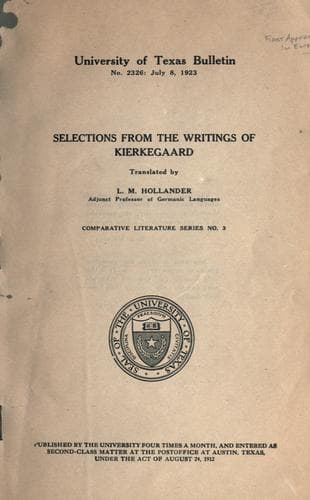
Selections from the Writings of KierkegaardKierkegaard, Søren
Religion
Selections from the Writings of Kierkegaard
Kierkegaard, Søren
Philosophy; Theology
All was lost, then, and more terribly than if a son had never
been given him! The Lord had only mocked Abraham, then! Miraculously
he had realized the unreasonable hopes of Abraham; and now he wished
to take away what he had given. A foolish hope it had been, but
Abraham had not laughed when the promise had been made him. Now
all was lost--the trusting hope of seventy years, the brief joy
at the fulfillment of his hopes. Who, then, is he that snatches
away the old man's staff, who that demands that he himself shall
break it in two? Who is he that renders disconsolate the grey hair
of old age, who is he that demands that he himself shall do it?
Is there no pity for the venerable old man, and none for the
innocent child? And yet was Abraham God's chosen one, and yet
was it the Lord that tempted him. And now all was to be lost!
The glorious remembrance of him by a whole race, the promise of
Abraham's seed--all that was but a whim, a passing fancy of the
Lord, which Abraham was now to destroy forever! That glorious
treasure, as old as the faith in Abraham's heart, and many, many
years older than Isaac, the fruit of Abraham's life, sanctified
by prayers, matured in struggles--the blessing on the lips of
Abraham: this fruit was now to be plucked before the appointed
time, and to remain without significance; for of what significance
were it if Isaac was to be sacrificed? That sad and yet blessed
hour when Abraham was to take leave from all that was dear to him,
the hour when he would once more lift up his venerable head,
when his face would shine like the countenance of the Lord, the
hour when he would collect his whole soul for a blessing strong
enough to render Isaac blessed all the days of his life--that
hour was not to come! He was to say farewell to Isaac, to be
sure, but in such wise that he himself was to remain behind;
death was to part them, but in such wise that Isaac was to die.
The old man was not in happiness to lay his hand on Isaac's head
when the hour of death came, but, tired of life, to lay violent
hands on Isaac. And it was God who tempted him. Woe, woe to the
messenger who would have come before Abraham with such a command!
Who would have dared to be the messenger of such dread tidings?
But it was God that tempted Abraham.
But Abraham had faith, and had faith for this life. Indeed, had
his faith been but concerning the life to come, then might he more
easily have cast away all, in order to hasten out of this world
which was not his....
Public-domain text, read in full here on John Shaqi.
Reviews
Reviews
No reviews yet
Be the first to share your thoughts on this work.
Elsewhere in the archive
Join the Discussion
Join the discussion
Sign in to leave a comment or review.
Sign InorCreate an account