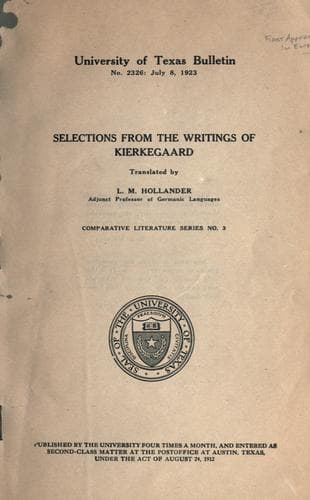
Selections from the Writings of KierkegaardKierkegaard, Søren
Religion
Selections from the Writings of Kierkegaard
Kierkegaard, Søren
Philosophy; Theology
But Abraham had faith and doubted not, but trusted that the
improbable would come to pass. If Abraham had doubted, then would
he have undertaken something else, something great and noble; for
what could Abraham have undertaken but was great and noble! He
would have proceeded to Mount Moriah, he would have cloven the
wood, and fired it, and unsheathed his knife--he would have cried
out to God: "Despise not this sacrifice; it is not, indeed, the
best I have; for what is an old man against a child foretold of
God; but it is the best I can give thee. Let Isaac never know
that he must find consolation in his youth." He would have plunged
the steel in his own breast. And he would have been admired
throughout the world, and his name would not have been forgotten;
but it is one thing to be admired and another, to be a lode-star
which guides one troubled in mind.
But Abraham had faith. He prayed not for mercy and that he might
prevail upon the Lord: it was only when just retribution was to
be visited upon Sodom and Gomorrha that Abraham ventured to beseech
Him for mercy.
We read in Scripture: "And God did tempt Abraham, and said unto
him, Abraham: and he said, Behold here I am.[3]" You, whom I
am now addressing did you do likewise? When you saw the dire
dispensations of Providence approach threateningly, did you not
then say to the mountains, Fall on me; and to the hills, Cover
me?[4] Or, if you were stronger in faith, did not your step
linger along the way, longing for the old accustomed paths, as
it were? And when the voice called you, did you answer, then, or
not at all, and if you did, perchance in a low voice, or whispering?
Not thus Abraham, but gladly and cheerfully and trustingly, and with
a resonant voice he made answer: "Here am I." And we read further:
"And Abraham rose up early in the morning.[5]" He made haste as
though for some joyous occasion, and early in the morning he was
in the appointed place, on Mount Moriah. He said nothing to Sarah,
nothing to Eliezer, his steward; for who would have understood him?
Did not his temptation by its very nature demand of him the vow of
silence? "He laid the wood in order, and bound Isaac his son, and
laid him on the altar upon the wood. And Abraham stretched forth
his hand, and took the knife to slay his son.[6]" My listener!
Many a father there has been who thought that with his child he
lost the dearest of all there was in the world for him; yet
assuredly no child ever was in that sense a pledge of God as
was Isaac to Abraham. Many a father there has been who lost his
child; but then it was God, the unchangeable and inscrutable
will of the Almighty and His hand which took it. Not thus with
Abraham. For him was reserved a more severe trial, and Isaac's
fate was put into Abraham's hand together with the knife. And
there he stood, the old man, with his only hope! Yet did he not
doubt, nor look anxiously to the left or right, nor challenge
Heaven with his prayers. He knew it was God the Almighty who
Public-domain text, read in full here on John Shaqi.
Reviews
Reviews
No reviews yet
Be the first to share your thoughts on this work.
Elsewhere in the archive
Join the Discussion
Join the discussion
Sign in to leave a comment or review.
Sign InorCreate an account