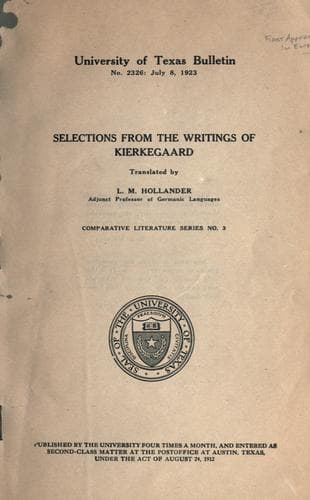
Selections from the Writings of KierkegaardKierkegaard, Søren
Religion
Selections from the Writings of Kierkegaard
Kierkegaard, Søren
Philosophy; Theology
An old saying, derived from the world of experience, has it that
"he who will not work shall not eat.[7]" But, strange to say, this
does not hold true in the world where it is thought applicable; for
in the world of matter the law of imperfection prevails, and we see,
again and again, that he also who will not work has bread to
eat--indeed, that he who sleeps has a greater abundance of it than
he who works. In the world of matter everything belongs to whosoever
happens to possess it; it is thrall to the law of indifference, and
he who happens to possess the Ring also has the Spirit of the Ring
at his beck and call, whether now he be Noureddin or Aladdin,[8] and
he who controls the treasures of this world, controls them, howsoever
he managed to do so. It is different in the world of spirit. There,
an eternal and divine order obtains, there the rain does not fall
on the just and the unjust alike, nor does the sun shine on the good
and the evil alike;[9] but there the saying does hold true that he
who will not work shall not eat, and only he who was troubled shall
find rest, and only he who descends into the nether world shall
rescue his beloved, and only he who unsheathes his knife shall be
given Isaac again. There, he who will not work shall not eat, but
shall be deceived, as the gods deceived Orpheus with an immaterial
figure instead of his beloved Euridice,[10] deceived him because
he was love-sick and not courageous, deceived him because he was
a player on the cithara rather than a man. There, it avails not
to have an Abraham for one's father,[11] or to have seventeen
ancestors. But in that world the saying about Israel's maidens
will hold true of him who will not work: he shall bring forth
wind;[12] but he who will work shall give birth to his own father.
There is a kind of learning which would presumptuously introduce
into the world of spirit the same law of indifference under which
the world of matter groans. It is thought that to know about great
men and great deeds is quite sufficient, and that other exertion
is not necessary. And therefore this learning shall not eat, but
shall perish of hunger while seeing all things transformed into
gold by its touch. And what, forsooth, does this learning really
know? There were many thousands of contemporaries, and countless
men in after times, who knew all about the triumphs of Miltiades;
but there was only one whom they rendered sleepless.[13] There
have existed countless generations that knew by heart, word for
word, the story of Abraham; but how many has it rendered sleepless?
Public-domain text, read in full here on John Shaqi.
Reviews
Reviews
No reviews yet
Be the first to share your thoughts on this work.
Elsewhere in the archive
Join the Discussion
Join the discussion
Sign in to leave a comment or review.
Sign InorCreate an account