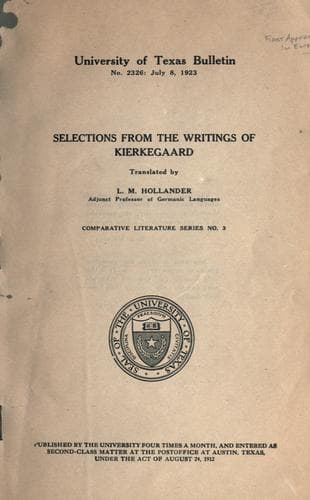
Selections from the Writings of KierkegaardKierkegaard, Søren
Religion
Selections from the Writings of Kierkegaard
Kierkegaard, Søren
Philosophy; Theology
Now the story of Abraham has the remarkable property of always
being glorious, in however limited a sense it is understood; still,
here also the point is whether one means to labor and exert one's
half. Now people do not care to labor and exert themselves, but
wish nevertheless to understand the story. They extol Abraham,
but how? By expressing the matter in the most general terms and
saying: "the great thing about him was that he loved God so ardently
that he was willing to sacrifice to Him his most precious possession."
That is very true; but "the most precious possession" is an indefinite
expression. As one's thoughts, and one's mouth, run on one assumes,
in a very easy fashion, the identity of Isaac and "the most precious
possession"--and meanwhile he who is meditating may smoke his
pipe, and his audience comfortably stretch out their legs. If
the rich youth whom Christ met on his way[14] had sold all his
possessions and given all to the poor, we would extol him as we
extol all which is great--aye, would not understand even him
without labor; and yet would he never have become an Abraham,
notwithstanding his sacrificing the most precious possessions he
had. That which people generally forget in the story of Abraham
is his fear and anxiety; for as regards money, one is not ethically
responsible for it, whereas for his son a father has the highest
and most sacred responsibility. However, fear is a dreadful thing
for timorous spirits, so they omit it. And yet they wish to speak
of Abraham.
So they keep on speaking, and in the course of their speech the
two terms Isaac and "the most precious thing" are used alternately,
and everything is in the best order. But now suppose that among
the audience there was a man who suffered with sleeplessness--and
then the most terrible and profound, the most tragic, and at the
same time the most comic, misunderstanding is within the range of
possibility. That is, suppose this man goes home and wishes to do
as did Abraham; for his son is his most precious possession. If a
certain preacher learned of this he would, perhaps, go to him, he
would gather up all his spiritual dignity and exclaim: "Thou
abominable creature, thou scum of humanity, what devil possessed
thee to wish to murder thy son?" And this preacher, who had not
felt any particular warmth, nor perspired while speaking about
Abraham, this preacher would be astonished himself at the earnest
wrath with which he poured forth his thunders against that poor
wretch; indeed, he would rejoice over himself, for never had he
spoken with such power and unction, and he would have said to
his wife: "I am an orator, the only thing I have lacked so far
was the occasion. Last Sunday, when speaking about Abraham, I
did not feel thrilled in the least."
Public-domain text, read in full here on John Shaqi.
Reviews
Reviews
No reviews yet
Be the first to share your thoughts on this work.
Elsewhere in the archive
Join the Discussion
Join the discussion
Sign in to leave a comment or review.
Sign InorCreate an account