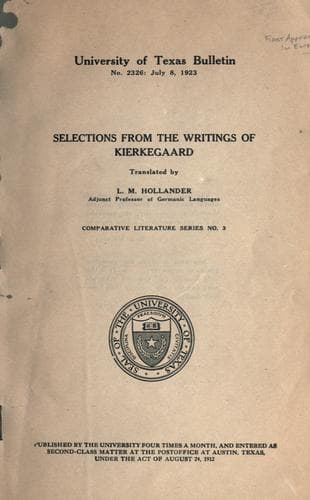
Selections from the Writings of KierkegaardKierkegaard, Søren
Religion
Selections from the Writings of Kierkegaard
Kierkegaard, Søren
Philosophy; Theology
Now I wonder if every one of my contemporaries is really able
to perform the movements of faith. Unless I am much mistaken
they are, rather, inclined to be proud of making what they perhaps
think me unable to do, viz., the imperfect movement. It is repugnant
to my soul to do what is so often done, to speak inhumanly about
great deeds, as if a few thousands of years were an immense space
of time. I prefer to speak about them in a human way and as though
they had been done but yesterday, to let the great deed itself
be the distance which either inspires or condemns me. Now if I,
in the capacity of tragic hero--for a higher flight I am unable
to take--if I had been summoned to such an extraordinary royal
progress as was the one to Mount Moriah, I know very well what I
would have done. I would not have been craven enough to remain
at home; neither would I have dawdled on the way; nor would I
have forgot my knife--just to draw out the end a bit. But I
am rather sure that I would have been promptly on the spot,
with every thing in order--in fact, would probably have been
there before the appointed time, so as to have the business
soon over with. But I know also what I would have done besides.
In the moment I mounted my horse I would have said to myself:
"Now all is lost, God demands Isaac, I shall sacrifice him, and
with him all my joy--but for all that, God is love and will
remain so for me; for in this world God and I cannot speak together,
we have no language in common."
Possibly, one or the other of my contemporaries will be stupid
enough, and jealous enough of great deeds, to wish to persuade
himself and me that if I had acted thus I should have done something
even greater than what Abraham did; for my sublime resignation
was (he thinks) by far more ideal and poetic than Abraham's
literal-minded action. And yet this is absolutely not so, for my
sublime resignation was only a substitute for faith. I could not
have made more than the infinite movement (of resignation) to
find myself and again repose in myself. Nor would I have loved
Isaac as Abraham loved him. The fact that I was resolute enough
to resign is sufficient to prove my courage in a human sense,
and the fact that I loved him with my whole heart is the very
presupposition without which my action would be a crime; but
still I did not love as did Abraham, for else I would have hesitated
even in the last minute, without, for that matter, arriving too
late on Mount Moriah. Also, I would have spoiled the whole business
by my behavior; for if I had had Isaac restored to me I would
have been embarrassed. That which was an easy matter for Abraham
would have been difficult for me, I mean, to rejoice again in
Isaac; for he who with all the energy of his soul _proprio motu
et propriis auspiciis_[16] has made the infinite movement of
resignation and can do no more, he will retain possession of
Isaac only in his sorrow.
Public-domain text, read in full here on John Shaqi.
Reviews
Reviews
No reviews yet
Be the first to share your thoughts on this work.
Elsewhere in the archive
Join the Discussion
Join the discussion
Sign in to leave a comment or review.
Sign InorCreate an account