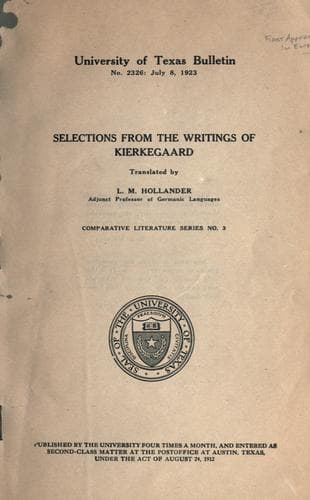
Selections from the Writings of KierkegaardKierkegaard, Søren
Religion
Selections from the Writings of Kierkegaard
Kierkegaard, Søren
Philosophy; Theology
But what did Abraham? He arrived neither too early nor too late.
He mounted his ass and rode slowly on his way. And all the while
he had faith, believing that God would not demand Isaac of him,
though ready all the while to sacrifice him, should it be demanded
of him. He believed this on the strength of the absurd; for there
was no question of human calculation any longer. And the absurdity
consisted in God's, who yet made this demand of him, recalling his
demand the very next moment. Abraham ascended the mountain and whilst
the knife already gleamed in his hand he believed--that God would
not demand Isaac of him. He was, to be sure, surprised at the
outcome; but by a double movement he had returned at his first
state of mind and therefore received Isaac back more gladly than
the first time....
On this height, then, stands Abraham. The last stage he loses
sight of is that of infinite resignation. He does really proceed
further, he arrives at faith. For all these caricatures of faith,
wretched lukewarm sloth, which thinks: "Oh, there is no hurry, it
is not necessary to worry before the time comes"; and miserable
hopefulness, which says: "One cannot know what will happen, there
might perhaps--," all these caricatures belong to the sordid view
of life and have already fallen under the infinite scorn of infinite
resignation.
Abraham, I am not able to understand; and in a certain sense I
can learn nothing from him without being struck with wonder. They
who flatter themselves that by merely considering the outcome of
Abraham's story they will necessarily arrive at faith, only deceive
themselves and wish to cheat God out of the first movement of
faith--it were tantamount to deriving worldly wisdom from the
paradox. But who knows, one or the other of them may succeed in
doing this; for our times are not satisfied with faith, and not
even with the miracle of changing water into wine--they "go
right on" changing wine into water.
Is it not preferable to remain satisfied with faith, and is it
not outrageous that every one wishes to "go right on"? If people
in our times decline to be satisfied with love, as is proclaimed
from various sides, where will we finally land? In worldly shrewdness,
in mean calculation, in paltriness and baseness, in all that
which renders man's divine origin doubtful. Were it not better
to stand fast in the faith, and better that he that standeth
take heed lest he fall;[17] for the movement of faith must ever
be made by virtue of the absurd, but, note well, in such wise
that one does not lose the things of this world but wholly and
entirely regains them.
Public-domain text, read in full here on John Shaqi.
Reviews
Reviews
No reviews yet
Be the first to share your thoughts on this work.
Elsewhere in the archive
Join the Discussion
Join the discussion
Sign in to leave a comment or review.
Sign InorCreate an account