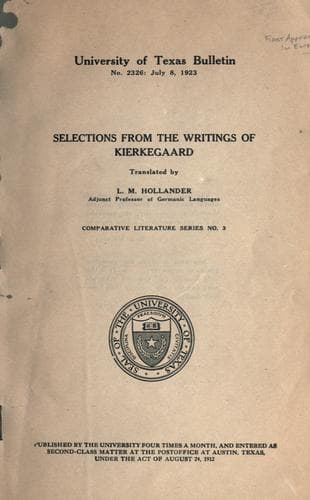
Selections from the Writings of KierkegaardKierkegaard, Søren
Religion
Selections from the Writings of Kierkegaard
Kierkegaard, Søren
Philosophy; Theology
But this miracle may so easily deceive one that it will be best
if I describe the movements in a given case which may illustrate
their aspect in contact with reality; and that is the important
point. Suppose, then, a young swain falls in love with a princess,
and all his life is bound up in this love. But circumstances are
such that it is out of the question to think of marrying her, an
impossibility to translate his dreams into reality. The slaves of
paltriness, the frogs in the sloughs of life, they will shout, of
course: "Such a love is folly, the rich brewer's widow is quite
as good and solid a match." Let them but croak. The knight of
infinite resignation does not follow their advice, he does not
surrender his love, not for all the riches in the world. He is
no fool, he first makes sure that this love really is the contents
of his life, for his soul is too sound and too proud to waste
itself on a mere intoxication. He is no coward, he is not afraid
to let his love insinuate itself into his most secret and most
remote thoughts, to let it wind itself in innumerable coils about
every fiber of his consciousness--if he is disappointed in his
love he will never be able to extricate himself again. He feels
a delicious pleasure in letting love thrill his every nerve, and
yet his soul is solemn as is that of him who has drained a cup
of poison and who now feels the virus mingle with every drop of
his blood, poised in that moment between life and death.
Having thus imbibed love, and being wholly absorbed in it, he
does not lack the courage to try and dare all. He surveys the
whole situation, he calls together his swift thoughts which like
tame pigeons obey his every beck, he gives the signal, and they
dart in all directions. But when they return, every one bearing
a message of sorrow, and explain to him that it is impossible,
then he becomes silent, he dismisses them, he remains alone;
and then he makes the movement. Now if what I say here is to
have any significance, it is of prime importance that the movement
be made in a normal fashion. The knight of resignation is supposed
to have sufficient energy to concentrate the entire contents
of his life and the realization of existing conditions into
one single wish. But if one lacks this concentration, this devotion
to a single thought; if his soul from the very beginning is
scattered on a number of objects, he will never be able to make
the movement--he will be as worldly-wise in the conduct of his
life as the financier who invests his capital in a number of
securities to win on the one if he should lose on the other;
that is, he is no knight. Furthermore, the knight is supposed
to possess sufficient energy to concentrate all his thought into
a single act of consciousness. If he lacks this concentration he
will only run errands in life and will never be able to assume
the attitude of infinite resignation; for the very minute he
approaches it he will suddenly discover that he forgot something
Public-domain text, read in full here on John Shaqi.
Reviews
Reviews
No reviews yet
Be the first to share your thoughts on this work.
Elsewhere in the archive
Join the Discussion
Join the discussion
Sign in to leave a comment or review.
Sign InorCreate an account