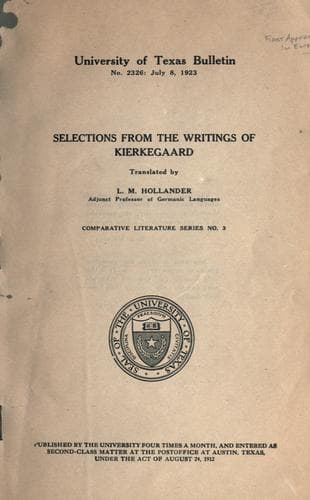
Selections from the Writings of KierkegaardKierkegaard, Søren
Religion
Selections from the Writings of Kierkegaard
Kierkegaard, Søren
Philosophy; Theology
so that he must remain behind. The next minute, thinks he, it
will be attainable again, and so it is; but such inhibitions
will never allow him to make the movement but will, rather,
tend to let him sink ever deeper into the mire.
Our knight, then, performs the movement--which movement? Is he
intent on forgetting the whole affair, which, too, would presuppose
much concentration? No, for the knight does not contradict himself,
and it is a contradiction to forget the main contents of one's
life and still remain the same person. And he has no desire to
become another person; neither does he consider such a desire to
smack of greatness. Only lower natures forget themselves and become
something different. Thus the butterfly has forgotten that it
once was a caterpillar--who knows but it may forget altogether
that it once was a butterfly, and turn into a fish! Deeper natures
never forget themselves and never change their essential qualities.
So the knight remembers all; but precisely this remembrance is
painful. Nevertheless, in his infinite resignation he has become
reconciled with existence. His love for the princess has become
for him the expression of an eternal love, has assumed a religious
character, has been transfigured into a love for the eternal being
which, to be sure, denied him the fulfillment of his love, yet
reconciled him again by presenting him with the abiding consciousness
of his love's being preserved in an everlasting form of which no
reality can rob him....
Now, he is no longer interested in what the princess may do, and
precisely this proves that he has made the movement of infinite
resignation correctly. In fact, this is a good criterion for
detecting whether a person's movement is sincere or just make-believe.
Take a person who believes that he too has resigned, but lo!
time passed, the princess did something on her part, for example,
married a prince, and then his soul lost the elasticity of its
resignation. This ought to show him that he did not make the
movement correctly, for he who has resigned absolutely is sufficient
unto himself. The knight does not cancel his resignation, but
preserves his love as fresh and young as it was at the first
moment, he never lets go of it just because his resignation is
absolute. Whatever the princess does, cannot disturb him, for it
is only the lower natures who have the law for their actions in
some other person, i.e. have the premises of their actions outside
of themselves....
Infinite resignation is the last stage which goes before faith,
so that every one who has not made the movement of infinite
resignation cannot have faith; for only through absolute resignation
do I become conscious of my eternal worth, and only then can
there arise the problem of again grasping hold of this world by
virtue of faith.
Public-domain text, read in full here on John Shaqi.
Reviews
Reviews
No reviews yet
Be the first to share your thoughts on this work.
Elsewhere in the archive
Join the Discussion
Join the discussion
Sign in to leave a comment or review.
Sign InorCreate an account