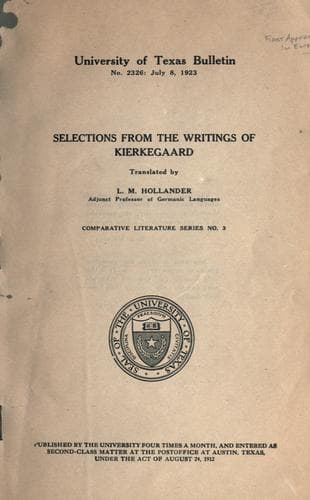
Selections from the Writings of KierkegaardKierkegaard, Søren
Religion
Selections from the Writings of Kierkegaard
Kierkegaard, Søren
Philosophy; Theology
But what means it, then, to labor and be heavy laden? Why does
he not offer a clearer explanation so that one may know exactly
whom he means, and why is he so chary of his words? Ah, thou
narrow-minded one, he is so chary of his words, lest he be narrow-minded;
and thou narrow-hearted one, he is so chary of his words lest
he be narrow-hearted. For such is his love--and love has regard
to all--as to prevent any one from troubling and searching his
heart whether he too be among those invited. And he who would
insist on a more definite explanation, is he not likely to be
some self-loving person who is calculating whether this explanation
does not particularly fit himself; one who does not consider that
the more of such exact explanations are offered, the more certainly
some few would be left in doubt as to whether they were invited?
Ah man, why does thine eye see only thyself, why is it evil because
he is good?[5] The invitation to all men opens the arms of him
who invites, and thus he stands of aspect everlasting; but no
sooner is a closer explanation attempted which might help one
or the other to another kind of certainty, than his aspect would
be transformed and, as it were, a shadow of change would pass
over his countenance.
"I will give you rest." Strange! For then the words "come hither
unto me" must be understood to mean: stay with me, I am rest;
or, it is rest to remain with me. It is not, then, as in other
cases where he who helps and says "come hither" must afterwards
say: "now depart again," explaining to each one where the help
he needs is to be found, where the healing herb grows which will
cure him, or where the quiet spot is found where he may rest
from labor, or where the happier continent exists where one is
not heavy laden. But no, he who opens his arms, inviting every
one--ah, if all, all they that labor and are heavy laden came
to him, he would fold them all to his heart, saying: "stay with
me now; for to stay with me is rest." The helper himself is the
help. Ah, strange, he who invites everybody and wishes to help
everybody, his manner of treating the sick is as if calculated
for every sick man, and as if every sick man who comes to him
were his only patient. For otherwise a physician divides his
time among many patients who, however great their number, still
are far, far from being all mankind. He will prescribe the medicine,
he will say what is to be done, and how it is to be used, and
then he will go--to some other patient; or, in case the patient
should visit him, he will let him depart. The physician cannot
remain sitting all day with one patient, and still less can he
have all his patients about him in his home, and yet sit all
day with one patient without neglecting the others. For this
reason the helper and his help are not one and the same thing.
The help which the physician prescribes is kept with him by the
patient all day so that he may constantly use it, whilst the
Public-domain text, read in full here on John Shaqi.
Reviews
Reviews
No reviews yet
Be the first to share your thoughts on this work.
Elsewhere in the archive
Join the Discussion
Join the discussion
Sign in to leave a comment or review.
Sign InorCreate an account